
The old farmhouse bathroom usually tells on itself before anything fails outright. The vinyl curls at the edges. The shower recess smells musty no matter how much you clean it. Someone has patched the wall behind the vanity twice, and the floor feels a bit off under work boots after a wet week.
On a rural property, that room does more than a suburban bathroom ever will. It cops red dust, muddy kids, stock hands, bore water, tank water, wet dogs, and long gaps between supply runs. If the layout is awkward or the waterproofing is ordinary, you feel it every day.
That’s why finding the right nsw rural bathroom builder matters. You don’t need generic renovation advice written for a townhouse in the city. You need a builder who understands creek crossings, reactive ground, septic tie-ins, BAL requirements, and the fact that a delayed delivery can throw out a whole week’s work on a remote place.
Your Guide to Building a Better Rural Bathroom
A lot of rural bathroom jobs start the same way. The room still works, technically, but only just. The shower is cramped, the vanity has no storage, the window doesn’t clear steam properly, and the floor finishes were never chosen for paddock life in the first place.

That’s become more common as more owners choose to upgrade what they’ve got instead of putting up with it. A 2025 survey found bathroom renovation intentions rose from 30% to 43% nationally, while 89% of households said rising living costs were a top concern. Even so, rural NSW owners often keep moving ahead with necessary upgrades, and the average bathroom renovation cost was $19,000 according to Awesim’s bathroom renovations overview.
That number matters, but the bigger point is this. On a working property, the bathroom isn’t a cosmetic room. It’s part of how the house functions day to day.
What a rural bathroom has to do well
A good rural bathroom needs to handle more than water.
- Clean up fast: Dust, mud, and grit should come off surfaces without a fight.
- Breathe properly: Good ventilation matters when windows stay shut in bad weather or high wind.
- Work with your services: Septic, tank water, bore water, and older plumbing all affect the design.
- Hold up over time: Cheap fittings don’t last when water quality is rough or maintenance access is limited.
A country bathroom doesn’t get judged on the day handover happens. It gets judged after winters, wet seasons, and harvest.
If you’re weighing up a renovation, extension, or a full strip-out, it helps to start with builders who already work on the land and understand those pressures. For broader rural building context, this guide on building with a rural builder in NSW is a useful place to start.
Planning Your Project Scope and Functionality
Before choosing tiles or tapware, decide what the room needs to do. That sounds obvious, but many bathroom projects falter at this initial stage. People plan around looks first, then spend years living with a room that still doesn’t suit the property.
Start with use, not style
A rural bathroom can serve very different roles from one home to the next. In one house it’s the main family bathroom. In another, it’s the room everyone enters after a day outside. On some properties it also needs to cope with guests, workers, or older family members.
Write down the real jobs the room handles now.
- Daily family use
- Mud and workwear clean-up
- Guest or worker overflow
- Accessible use for ageing in place
- Laundry overlap or rear-entry traffic
If the bathroom sits near the back entry, hard-wearing floors and easy-clean wall finishes usually beat delicate choices. If it’s the only bathroom in the house, storage and circulation matter more than decorative extras.
Decide how far the job goes
Not every project needs a full gut job. Some do.
A practical way to sort the scope is to split the room into four parts:
| Part of the job | Keep and improve | Replace fully |
|---|---|---|
| Layout | Works well enough | Traffic flow is poor or unsafe |
| Plumbing | Services are sound | Pipework is old, awkward, or unreliable |
| Surfaces | Cosmetic wear only | Water damage, movement, or mould issues |
| Fixtures | Outdated but usable | Failing, undersized, or wrong for the household |
If the layout is bad, patching fixtures rarely solves the underlying problem. A nicer vanity won’t fix a bathroom where the door hits the toilet, the shower is too tight, or there’s nowhere to hang wet gear.
Rural details people forget
At this point, the country jobs separate themselves from town work.
- Water source: Tank and bore water can influence fixture choice and maintenance.
- Wastewater setup: Septic and on-site systems affect plumbing decisions and approvals.
- Cleaning reality: Open shelves and fiddly profiles collect dust fast.
- Natural light: A well-placed window makes a bathroom easier to use and easier to keep dry.
- Ventilation path: Steam has to leave the room. If it doesn’t, linings and joinery suffer.
Practical rule: If a feature makes cleaning harder, servicing harder, or repairs harder, it needs to justify itself.
Build a brief that a builder can price properly
A good brief doesn’t have to be fancy. It just has to be clear.
Include the must-haves, the nice-to-haves, and the things that are essential because of the property. That might be a hobless shower, stronger wall backing for grab rails, a full-height tile shower recess, or better separation between the wet area and the rest of the room.
That sort of clarity saves arguments later. It also helps the builder tell you early what’s workable, what’s wasteful, and what won’t perform on a rural site.
Mastering Remote Site Logistics and Access
The hardest part of many rural bathroom jobs isn’t the tiling or cabinetry. It’s getting the right people, materials, and equipment onto the site at the right time.
That issue gets underestimated all the time by builders who mainly work in town. A neat quote on paper doesn’t mean much if the road in turns to slurry after rain, the crossing is running, or the delivery truck won’t go past the front gate.

Why remote access changes the whole job
On a remote block, logistics affect nearly every trade decision. Plasterboard, sheet linings, waterproofing products, vanities, shower screens, cement products, and steel all need to arrive in good condition. If one load misses the window, the sequence can unravel.
That’s not just anecdotal. Data from the NSW Department of Planning shows that 25% of rural builds in remote areas like Bourke and Broken Hill exceed budgets by as much as 30%, largely due to material transport challenges. Over the past year, freight costs for heavy construction items to outback sites have risen by 18% according to this regional investment and planning reference.
For bathroom work, delays hit harder than people expect. Waterproofing, screeds, plumbing rough-in, fit-off, and glazing all depend on proper sequencing. If materials are late, trades stand around or leave for another job.
What actually works on rural sites
A rural builder needs to think like a builder and a logistics operator at the same time.
The basics matter:
- Road assessment: Dirt roads, ruts, grades, and turning circles need checking before the job starts.
- Crossing checks: Water crossings can change access overnight.
- Gate width and clearance: Large deliveries fail on simple access details more often than people think.
- Staging areas: Materials need a dry, stable place on site.
- Load planning: Heavy items should arrive in the right order, not just all at once.
Where specialist access matters most is on properties well away from suppliers. That’s why proper rural capability matters. A builder with 4×4 utes and a 10 tonne 4×4 truck can bring in labour, materials, and equipment where and when they’re needed most, including heavier bathroom and structural loads that ordinary delivery vehicles won’t reliably carry into remote country.
If your site access is hard, transport isn’t a side issue. It’s the job.
A short look at remote site access in action helps explain the difference:
What doesn’t work
Some approaches create trouble almost every time.
- Relying on standard metro deliveries: They often stop at the first access issue.
- Ordering too tight to schedule: There’s no buffer for weather, road damage, or supplier misses.
- Using fragile finishes too early: They can be damaged if the site is still rough and active.
- Treating remote freight as a minor line item: It isn’t.
The best rural bathroom projects are organised with access in mind from day one. That’s how you avoid waste, idle labour, broken sequencing, and the sort of avoidable budget drift that owners remember for years.
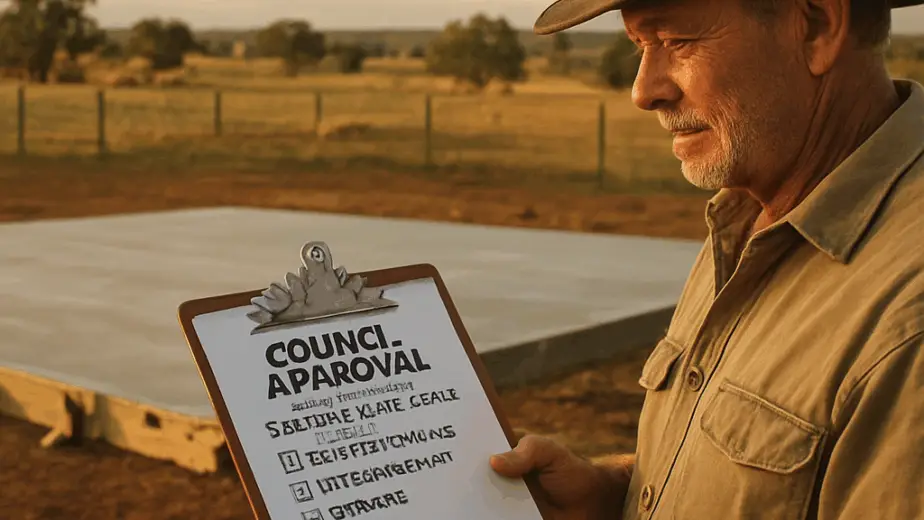
Navigating Council Approvals and Australian Standards
A bathroom might look straightforward, but compliance can get technical fast on a rural property. The room itself is only part of the job. Plumbing, drainage, waterproofing, structure, fire exposure, and wastewater all have to line up.
That’s why approvals matter. They aren’t paperwork for paperwork’s sake. They protect the building, the occupants, and the value of the work.

The rules that affect bathroom layout
Space planning has legal and practical consequences. The NSW Guide to Standards and Tolerances 2017 includes minimum bathroom dimensions such as a 0.9m x 0.9m shower enclosure. It also notes that construction in many rural NSW areas must comply with AS 3959 for bushfire-prone land, a standard relevant to over 70% of the region, requiring non-combustible materials for fixtures and finishes as referenced in this building design specification resource.
If a shower is too tight, access is awkward and cleaning is worse. If circulation is poor, the room can feel cramped no matter how nice the finishes are. On older farmhouses, that often means reworking walls or openings instead of trying to squeeze a new fit-out into a bad footprint.
The approvals that catch owners out
Not every bathroom project follows the same approval path. Some stay within straightforward renovation territory. Others trigger wider checks because the work touches drainage, wastewater, additions, or bushfire controls.
Common issues include:
- Plumbing changes: New fixture locations can affect drainage and venting.
- Septic or on-site wastewater implications: Altered loads or connections can require separate review.
- Bushfire-prone land requirements: Material selection and detailing can change.
- Heritage or local overlays: Older buildings may have extra conditions.
- Structural changes: Moving windows, doors, or walls can change engineering requirements.
Why rural compliance needs local judgement
The code book doesn’t see your block. It doesn’t know if access is difficult, if water supply is limited, or if the bathroom sits in an old part of the house with movement in the floor.
That’s where experienced judgement matters. Rural work often needs practical solutions that stay compliant without pretending the building is new and square.
Good compliance work is quiet. You notice it years later when the room still performs, the paperwork is clean, and nothing needs explaining at sale time.
Choosing Durable Materials for the Rural Environment
Materials that look good in a showroom can fail quickly on a property. Dust works into tracks and hinges. Bore water marks cheap finishes. Sun and heat punish poorly chosen sealants. If the house sits in a bushfire-prone area, the wrong material can also create a compliance problem.
Pick surfaces for cleaning and wear
The best rural bathroom materials are the ones you don’t have to fuss over.
For floors, textured porcelain tiles usually make more sense than delicate polished finishes. They clean up well and don’t show every bit of dirt. For wall linings in wet areas, fully waterproofed, properly tiled surfaces remain a dependable option when the substrate and prep work are right.
Vanities need careful thought. Fancy profiled doors and thin laminates don’t always love steam, dust, and rough use. Simpler fronts, solid carcass construction, and practical hardware tend to age better.
Bushfire exposure changes the material list
This part gets ignored too often in generic renovation advice. More than 180,000 hectares in NSW’s rural regions were affected by bushfires in the 2023-24 season, and BAL compliance means choosing non-combustible materials like Colorbond steel and properly treated timbers where required under NSW Rural Fire Service guidance according to this NSW bushfire compliance reference.
That doesn’t mean every bathroom has to feel industrial. It means the material schedule has to respect the property’s fire context, especially for external wall interfaces, windows, vents, and adjoining structures.
For readers comparing options in more detail, this page on NSW rural bathroom renovations gives useful project context.
Rural Bathroom Material Comparison
| Component | Material Option | Durability Rating (1-5) | Maintenance Level | Best For |
|---|---|---|---|---|
| Flooring | Textured porcelain tile | 5 | Low | Main family bathrooms, rear-entry bathrooms |
| Flooring | Vinyl planks or sheet vinyl | 3 | Medium | Budget-conscious dry-area use, not ideal for heavy wet-room wear |
| Vanity | Moisture-resistant laminate cabinetry | 4 | Low | Everyday use with sensible detailing |
| Vanity | Solid timber | 3 | High | Feature vanities where ongoing maintenance is acceptable |
| Wall lining | Full-height ceramic or porcelain tile | 5 | Low | Showers and heavy-use wet zones |
| Wall lining | Painted fibre cement in selected areas | 4 | Medium | Lower-splash zones with good ventilation |
| Fixtures and trim | Colorbond steel elements where suitable | 5 | Low | Bushfire-conscious detailing and hardy external-adjacent elements |
| Screens | Toughened glass | 4 | Medium | Clean, durable shower enclosures with proper maintenance |
What holds up and what often disappoints
Some trade-offs are worth making. Others aren’t.
- Worth it: Better tapware internals, tougher tiles, quality waterproofing systems, and simpler joinery profiles.
- Usually not worth it: Delicate coatings, hard-to-source fittings, deep grooves that trap dust, and trend-driven finishes that age badly.
- Depends on the house: Timber features can work well if they’re detailed properly and used in the right locations.
The room should suit the property, not fight it. Materials need to match the way people actually live on the land.
Understanding Project Costs and Timelines in Rural NSW
Cost planning gets messy when owners compare a rural bathroom to a suburban quote pulled off the internet. The rooms might look similar on a plan, but they aren’t being built under the same conditions.
In 2025, NSW households led the country in home renovation spending at an average of $78,500, with bathroom projects a major priority, and the national renovation market valued at $48 billion according to the Housing Industry Association’s NSW building update. On rural properties, the same room can cost more or take longer because access, services, and sequencing are harder.
What pushes cost up
Three things usually drive the budget.
First is scope. A fixture swap is one thing. A full strip-out with plumbing relocation, floor correction, waterproofing rebuild, and custom joinery is another.
Second is site condition. Older farmhouses often hide movement, out-of-square walls, patch repairs, and service issues.
Third is logistics. The further the site is from suppliers and trades, the more important planning becomes.
A practical way to think about budget is by category rather than by a fake universal rate:
- Light upgrade: Keeping the layout, replacing selected fixtures and finishes.
- Standard renovation: New waterproofing, tiling, vanity, shower, and plumbing fit-off within the existing footprint.
- Complex rural renovation: Structural corrections, layout changes, service upgrades, custom joinery, difficult access, or integration with older buildings.
Timelines follow decisions
Straightforward bathrooms can move well when materials, trades, and approvals line up. Complex jobs take longer because the sequence is less forgiving.
The jobs that drag out usually have one of these problems:
| Delay source | What it affects |
|---|---|
| Late selections | Joinery, screens, tiles, tapware |
| Hidden site issues | Demolition, framing, floor prep |
| Access interruptions | Deliveries, labour, heavy materials |
| Approval uncertainty | Start dates and service alterations |
For owners who like visibility during the build, even a simple digital workflow helps. Tools like construction project management software can make approvals, variations, selections, and scheduling easier to track, especially when you’re managing a property from a distance or juggling farm operations at the same time.
If you’re trying to price the job sensibly before committing, this guide on the cost of bathroom renovations is a practical starting point.
What helps the job stay on track
Lock in fixtures early. Confirm access before materials are ordered. Make sure everyone understands whether the bathroom is the only one in the house. And don’t assume the cheapest quote is the lowest final cost.
Good rural planning rarely looks dramatic. It just avoids the silly losses.
Frequently Asked Questions for Your Bathroom Build
How do I prepare the property before the build crew arrives
Make access easy and obvious. Mark gates, let the team know about dogs and stock movement, and point out any soft ground, crossings, or places heavy vehicles shouldn’t go.
Inside the house, clear the route from entry to bathroom. Remove personal items, medicines, linen, and loose storage. If the bathroom is the only one on site, sort out temporary arrangements early.
What should I prioritise if the budget won’t stretch to everything
Fix the things that fail first. Waterproofing, drainage falls, ventilation, damaged substrates, and poor layout beat cosmetic upgrades every time.
If the budget is tight, keep the design simple and spend on the bones of the room. A plain bathroom built properly is better than a stylish one with weak prep and average materials.
How do I make a new bathroom easier to maintain on a farm or acreage
Choose surfaces that clean fast and don’t need special treatment. Keep joins, ledges, and decorative grooves to a minimum.
A few habits help after handover:
- Run ventilation properly: Let steam clear before shutting the room up.
- Wipe down wet zones: It reduces mineral build-up where water quality is harsh.
- Check sealant and grout lines: Small failures are easier to repair early.
- Keep external drainage working: Water outside the house can affect what happens inside over time.
Are water-efficient fixtures worth it on tank water
Yes, if the products suit the household and the rest of the plumbing setup. On tank water, sensible fixture choice helps preserve supply without making the room frustrating to use.
The key is balance. A shower that saves water but delivers a miserable experience won’t get much love. Good fixture selection considers pressure, comfort, maintenance, and how the property operates.
How do I know if a builder really understands rural work
Ask direct questions. How do they handle access after rain? What’s their plan if standard deliveries can’t get in? Have they worked with septic, tank water, bushfire requirements, and older homesteads before?
You can also look at how they present themselves online. For contractors wanting to improve how local clients find them, this Local SEO Playbook for Contractors gives a useful look at how strong regional operators build trust before the first phone call.
What’s the biggest mistake owners make
Changing key decisions too late. Late changes to layout, tiles, screens, plumbing locations, or joinery create waste and delays fast, especially on rural jobs where replacements aren’t around the corner.
The second biggest mistake is choosing a builder who prices the room but doesn’t understand the property.
If your farmhouse, station homestead, or regional home needs a bathroom that’s built for real rural use, talk to Awesim Building Contractors. Glen and the team bring 35 years of hands-on building experience across regional New South Wales, along with 4×4 utes and a 10 tonne 4×4 truck that can get labour, materials, and equipment into remote properties where access is half the battle.