Putting up a new warehouse on your property is a serious investment, one that will define your operations for years to come. It’s about much more than just throwing up some steel and cladding; the real work happens long before the first shovel hits the dirt. A successful build is one that’s thoroughly planned, not just built.
Your Pre-Construction Blueprint for a Rural Warehouse
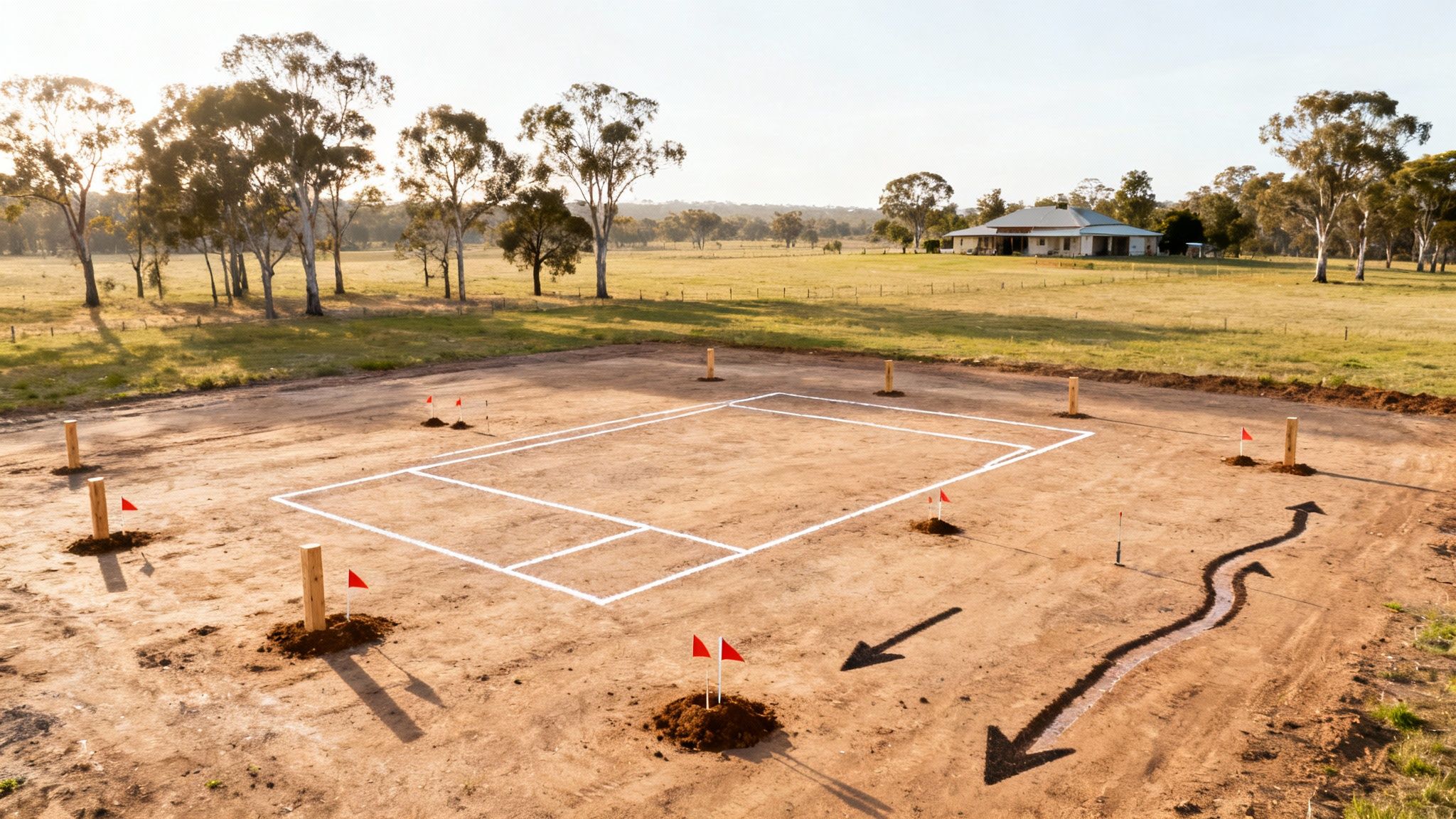
Before a single post hole is dug, getting the groundwork right is absolutely crucial. This planning phase is your chance to make sure the shed’s design truly matches what you need it for, to tackle the unique challenges of your block, and to build something that will last. Trying to wing it at this stage almost always leads to expensive fixes down the track and a building that just doesn't quite work.
A solid blueprint begins with a real understanding of your property and what you want to achieve with the building. This is where getting an expert eye on it pays dividends, helping turn your ideas into a plan that's practical and actually buildable.
Conducting a Meaningful Site Assessment
First things first, you need to do more than just find a flat bit of ground. A proper site assessment for a rural shed looks at all the little things that can make a big difference to the build and the building’s lifespan.
We always look at the practical details that are so often missed:
- Soil Stability and Composition: Can the ground actually handle a loaded concrete truck or a crane without turning into a bog? Clay soils react very differently to rain compared to sandy loam, and that directly impacts your foundation design.
- Water Drainage Patterns: After a big downpour, where does the water go? Siting the shed correctly means you won't end up with a pond on your new floor. You want to actively channel water away from the slab, not towards it.
- Prevailing Wind Direction: This is a big one for roller door placement. A huge door facing directly into a southerly buster can be a nightmare to open and puts a lot of strain on the tracks and motor over the years.
- Sun Orientation: A bit of smart positioning can make a real difference to comfort. You can place office windows to catch the morning sun but shield the main work area from that scorching afternoon heat.
Aligning Function with Design and Footprint
What you’re going to do in the warehouse dictates everything about its design. A shed for hay storage is a completely different beast to a machinery workshop or a depot for bagged feed.
You’ve got to ask the right questions:
- Machinery Storage: What’s the turning circle on your biggest bit of gear? The bay layout and door widths need to let you get in and out without a 10-point turn.
- Workshop Space: Do you need a dedicated welding bay, an area for servicing vehicles, or just some good workbench space? This all affects where internal walls, power points, and ventilation go.
- Future Expansion: Think you might need more space in ten years? It’s smart to design the shed with one "clean" wall—no doors or major services—to make adding an extension down the line much simpler and cheaper.
A well-planned warehouse should feel like a natural part of your farm's workflow, not an obstacle. Thinking about the access tracks from your other sheds, the homestead, and the paddocks is just as critical as the design of the building itself.
Overcoming Remote Access Challenges
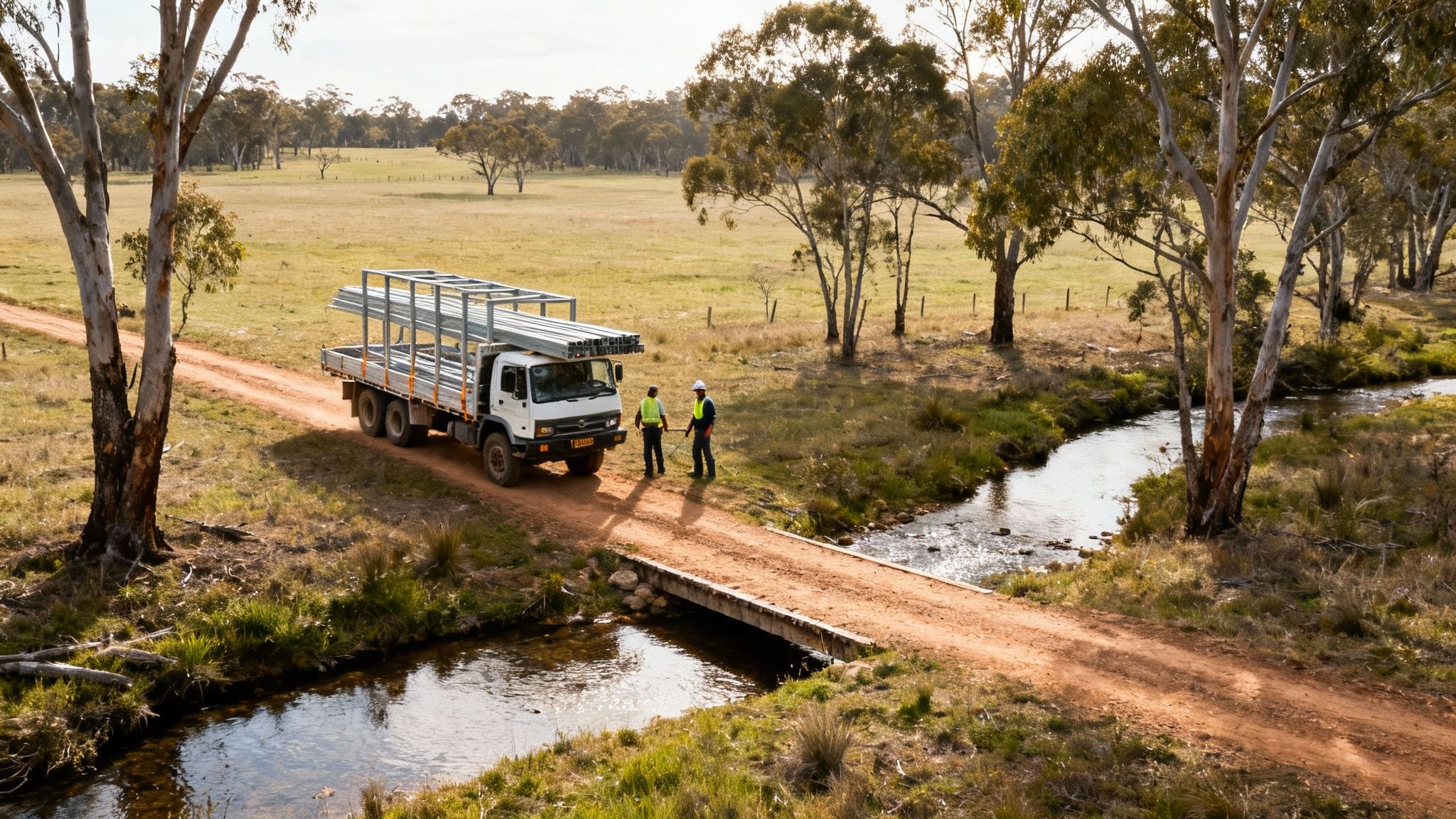
Let’s be honest, one of the biggest headaches with building in rural NSW is logistics. Getting materials, machinery, and a good crew out to a remote property with dirt roads or creek crossings can be a nightmare. We’ve made this a core part of our planning. We have a 10 tonne 4×4 truck to bring in materials and supplies for the most remote properties around New South Wales. This allows us to bring in labour, materials and equipment where & when it's needed the most. It means we can keep your project moving, no matter how far off the beaten track you are.
Ultimately, the blueprint phase is all about asking the right questions upfront to avoid problems later. For a deeper look at one of the most critical parts of the build, check out our guide on https://awesim.au/concrete-slab-thickness-for-shed-a-stepbystep-guide-for-nsw-farms/. And don't forget power; planning for your needs with the right electrical substation design ensures your new warehouse is ready to work from day one.
2. Navigating Council Permits and NSW Regulations
Let's be honest, the paperwork for a rural build can feel like the biggest hurdle of the entire project. But getting this part right from the beginning saves you a world of headaches, delays, and unexpected costs down the track. Understanding your local council's approval process in regional New South Wales is the key to a smooth start.
While every council, from the Hunter Valley to the Riverina, has its own local flavour, the fundamental rules are pretty consistent. Your first job is to work out which approval path you need to take.
CDC vs. a Full-Blown DA
For smaller, more straightforward sheds, you might get lucky and qualify for a Complying Development Certificate (CDC). Think of it as the express lane for projects that neatly tick all the pre-determined boxes. It's faster and less of a bureaucratic maze.
However, for anything substantial—like a large warehouse or a complex custom build—you’ll almost certainly be lodging a full Development Application (DA).
Getting Your Development Application Right
A DA is the deep dive. This is where council planners scrutinise your proposal against their local environmental plans, zoning maps, and potential impact on the community. Having all your ducks in a row here isn't just a good idea; it's non-negotiable.
They need to see you've thought everything through. You'll typically need to pull together:
- Detailed Site Plans: These aren't just rough sketches. They need to show the exact location of the new building, property boundaries, any existing structures, and critical access points.
- Engineering Specifications: A certified engineer will need to provide drawings that prove the foundation and frame are structurally sound and meet Australian standards.
- Environmental Impact Statement: If your site is near sensitive bushland, a creek, or significant trees, you might need a report on potential environmental effects and how you plan to manage them.
Pro Tip: Before you spend a cent on professional reports or detailed drawings, have an initial chat with someone in the council's planning department. It’s the single best way to clarify what they actually expect to see in your application.
This groundwork is absolutely essential for a smooth approval. A solid understanding of the general building regulations is your foundation here, as these rules underpin the entire Building Code of Australia (BCA). The BCA sets the minimum standards for everything—from structural integrity and fire safety right through to energy efficiency.
Rural-Specific Compliance You Can't Ignore
Building out in the country brings its own unique set of compliance checks that you just don't see in town.
Councils are particularly focused on bushfire safety, especially if your property falls within a designated Bushfire Prone Land area. This will likely dictate some of your material choices (hello, Colorbond) and require you to establish and maintain an Asset Protection Zone (APZ) around the warehouse.
Water management is another big one. With a massive roof area, you’re going to collect a serious amount of water during a downpour. Your plans must clearly show how you'll handle that stormwater to prevent erosion on your land or flooding your neighbours.
For a more detailed look at the rules for smaller structures, our guide covers everything you need to know about https://awesim.au/do-you-need-council-approval-for-a-shed/.
The boom in sheds and warehouses isn't just a feeling; it’s a major economic trend. Across Australia, warehouse construction has become a massive slice of the non-residential building pie, driven by the needs of e-commerce and expanding regional supply chains. In fact, the value of construction work on warehouses shot up to over $8.9 billion AUD in 2024—a staggering jump of about 48% in just twelve months. It really shows just how critical these buildings have become.
Choosing Materials That Withstand the Australian Climate
The longevity of your warehouse comes down to one thing: the materials you choose. Out in regional New South Wales, this isn't just a recommendation; it's a critical decision. Your shed needs to be tough enough to handle everything the Aussie climate throws at it—from blistering summer heat and relentless UV to sudden hailstorms and frosty winter mornings.
Picking the right components isn't about finding the cheapest option on the day. It's an investment in resilience. The real goal is to build a structure that will stand strong for decades, demanding very little from you in terms of maintenance while adding lasting value to your property.
Framing: The Backbone of Your Build
The frame is the skeleton of your warehouse, and for rural construction, you're looking at two main contenders: structural steel or treated timber.
Structural steel is often the go-to choice, and for good reason. Its sheer strength is unmatched, it's fire-resistant, and it’s completely immune to termites—a major headache in many parts of NSW. Steel framing allows for those huge, clear-span designs perfect for storing large machinery, all without needing support columns getting in the way. Plus, its precision engineering usually means a quicker assembly on-site.
On the other hand, treated timber, especially options like Laminated Veneer Lumber (LVL), gives you an excellent strength-to-weight ratio and can be a more budget-friendly choice for certain designs. It also has a natural flexibility that can be a real advantage. The key, of course, is ensuring it's properly treated to fend off moisture and pests.
While you're weighing up these material choices, your permit application process will be running in parallel. Getting this right is just as important as the physical build itself.
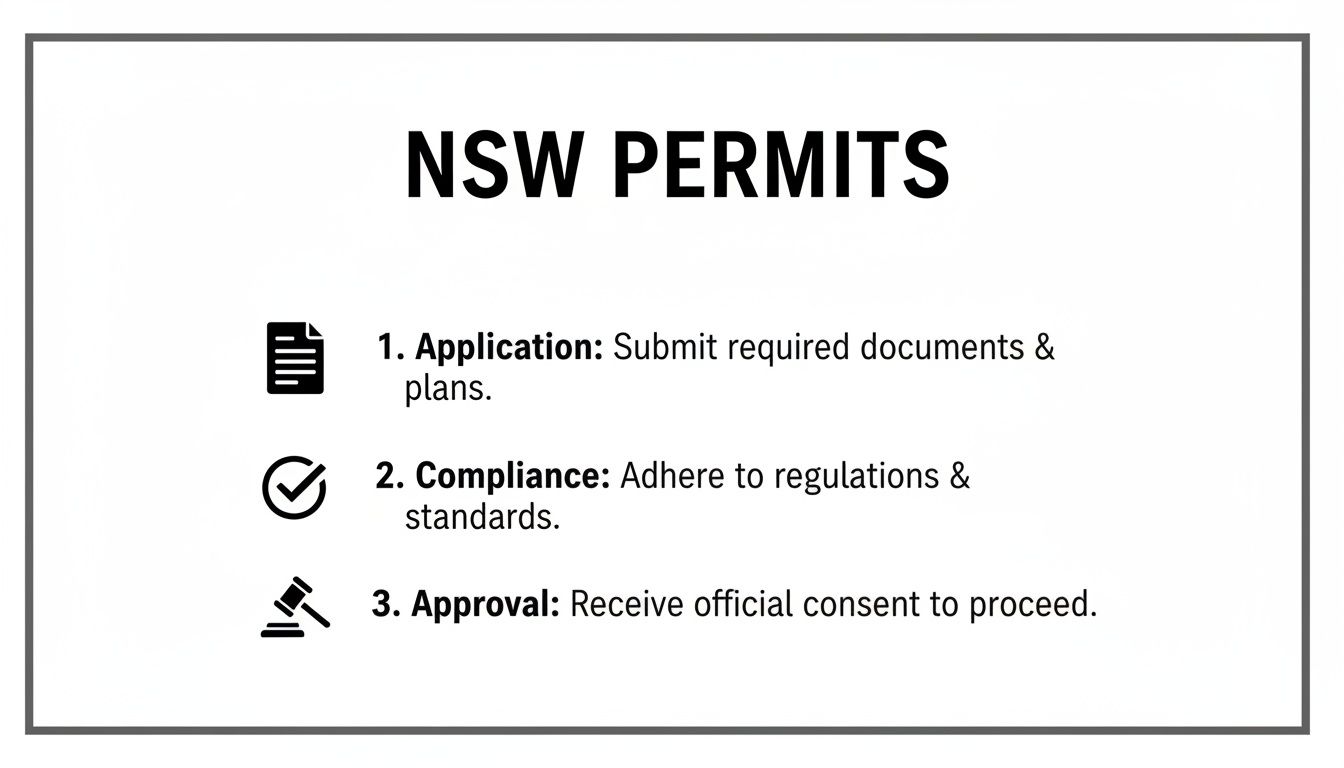
This diagram breaks down the council approval journey into three clear stages: the initial Application, ensuring Compliance with all regulations, and finally, getting that all-important Approval.
The Importance of High-Quality Cladding
Your warehouse's first line of defence against the weather is its cladding. This is absolutely not the place to skimp. For the harsh Australian climate, you simply can't go past Australian-made Colorbond steel for both walls and roofing.
There’s a reason you see it on almost every farm shed in the country:
- Built Tough: It's tested in some of Australia's most extreme conditions, engineered to resist chipping, flaking, and blistering under the sun.
- Thermally Smart: Choosing lighter colours from the Colorbond range helps reflect the sun's heat, keeping the inside of your shed noticeably cooler on those scorching 40-degree days.
- Low Maintenance: The colour is bonded to the steel, meaning you won't be out there every few years with a paint roller. It holds its own for decades.
Your choice of cladding has a massive impact on the long-term cost of owning your shed. Investing in a proven, premium material like Colorbond from the start will save you a fortune in future maintenance and protect the entire structure.
Of course, even the toughest materials can get damaged by a freak storm or an accidental knock from the tractor. Knowing how to handle these situations is part of being a property owner. For a deeper dive, check out our guide on cladding replacement and repair services.
Comparing Common Warehouse Building Materials for NSW Conditions
Choosing the right combination of materials is a balancing act between durability, cost, and maintenance. Here's a look at how the most common options stack up for a rural NSW build.
| Material Component | Popular Options | Key Advantages | Considerations |
|---|---|---|---|
| Framing | Structural Steel, Treated Timber (LVL) | Steel: High strength, fire/termite resistant, ideal for wide spans. Timber: Good strength-to-weight, can be more cost-effective, flexible. | Steel: Higher upfront cost. Timber: Must be correctly treated for termites and moisture; span limitations compared to steel. |
| Cladding | Colorbond Steel | Extremely durable, low maintenance, thermally efficient (light colours), designed for AU conditions. | Higher initial cost than some alternatives, but lower lifetime cost. Requires professional installation for warranty. |
| Roofing | Insulated Sandwich Panels, Colorbond Steel with Insulation Blanket | Insulated Panels: Superior thermal performance, all-in-one solution. Colorbond: Proven durability, excellent for water harvesting when paired with insulation. | Insulation is a must for temperature control; ensure proper fall for water runoff and guttering design for rainwater collection. |
| Foundations | Reinforced Concrete Slab | Provides a solid, level, and durable base for heavy machinery and storage. Engineered for specific load requirements. | The most expensive part of the build; requires careful planning for drainage and load points. Soil tests are crucial. |
This table highlights that while initial cost is a factor, the real value lies in choosing materials that minimise ongoing work and stand up to the local environment.
Foundations and Roofing Systems
A solid foundation is completely non-negotiable. We're talking about a structure that needs to support heavy tractors, loaded trucks, or hundreds of tonnes of hay. A reinforced concrete slab is the industry standard, but it can’t be a one-size-fits-all approach. The slab's thickness and the gauge of the steel reinforcement must be properly engineered for the heaviest load you’ll ever put on it.
Likewise, the roof does more than just keep the rain out. An insulated roof is a smart play, drastically cutting down heat transfer and making the space workable all year round. A well-designed roof with the right guttering and downpipes also becomes a massive asset for rainwater harvesting—a simple way to capture a precious resource from your building’s large footprint.
Solving Logistics for Remote Construction Sites
It doesn't matter how good your materials are or how skilled your team is if you can't get them to the site. When you're building a warehouse in a remote part of New South Wales, logistics isn't just a line item in the plan—it is the plan.
Getting everything you need to a property that's miles down an unsealed road, sits behind a seasonal creek crossing, or is at the mercy of sudden weather is often the single biggest hurdle we see in rural construction. A successful build out here hinges on a logistics strategy that sees problems coming and solves them before they happen. It’s about more than just booking a truck and hoping for the best.
Overcoming the Tyranny of Distance and Terrain
The most common mistake people make is underestimating just how challenging their property access really is. A track that’s a breeze in a ute can become a boggy, impassable mess for a semi-trailer loaded with steel frames after a single downpour. A dry creek bed in January can be a torrent in July, cutting off your site for days on end.
A practical logistics plan has to account for all these variables. It means carefully coordinating every delivery to minimise downtime and having a solid system for storing materials on-site, protecting them from the elements once they finally arrive.
Our Specialised Solution for Remote Access
This is precisely why we’ve invested heavily in our own specialised equipment. We know what it's like building in the bush. The key to our whole strategy is our 10-tonne 4×4 truck. This isn't your average delivery vehicle; it's a purpose-built machine designed to handle the toughest terrain regional NSW can throw at it.
This heavy-duty truck gives us a massive advantage. We can confidently bring everything needed for your warehouse directly to your site, including:
- Our Team: We get our skilled crew to and from your property reliably, day in and day out, which keeps the project moving forward.
- All Materials: From the heavy structural steel and roofing sheets right down to pallets of concrete mix, we deliver it right to the building footprint.
- Essential Equipment: We can also haul in the necessary machinery and tools exactly when and where they’re needed most.
Having this 4×4 capability is a genuine game-changer. It means we aren’t relying on third-party couriers who might turn around at the first sign of a dirt road. We take full responsibility for getting supplies to even the most isolated properties, making sure your project stays on schedule, no matter the access issues.
This approach turns logistical nightmares into manageable tasks. Instead of your project’s timeline being dictated by road conditions or the whims of freight companies, we control the supply chain right to your doorstep. This is essential for keeping rural projects on time and on budget.
Professional Tips for On-Site Management
Once the materials are there, managing them properly is the next challenge. A well-organised site is a safe and efficient one, so we always plan our laydown areas before the first delivery even shows up.
Think through the construction sequence. The materials you'll need first—like your foundation mesh and the main frame components—should be stored in the most accessible spots. Cladding and roofing, which go on later, can be placed further back. This simple bit of foresight stops you from having to constantly shuffle heavy pallets around, which saves a huge amount of time and reduces the risk of damage.
Protecting materials from the harsh Australian climate is also vital. All timber needs to be kept up off the ground on bearers and covered with tarps to stop it from absorbing moisture. Steel components and roofing sheets have to be stored correctly to prevent scratches and allow air to circulate, which stops condensation from forming and causing surface rust. This attention to detail ensures every high-quality material you've invested in is in perfect condition when it's time for installation.
How to Manage Your Project Budget and Timeline
Keeping your warehouse project on track, both financially and chronologically, isn’t about guesswork—it's about proactive management. A well-defined budget and a realistic timeline are the two most critical tools you have. Without them, you're building blind, and small hiccups can quickly snowball into major, expensive problems.
The financial side of your build is far more than just a final number. It’s about understanding every line item that adds up to that total, which gives you the control to make smart decisions along the way. Transparency from the get-go is the only way to avoid nasty surprises when the invoices start rolling in.
Identifying the Major Cost Centres
When you're putting a budget together for a new shed or warehouse, the costs will fall into a few key buckets. Getting a handle on these upfront is the best way to stop costs from creeping up later.
- Preliminary Costs: Think council fees for your Development Application (DA), any land surveys needed, and those all-important engineering reports.
- Site Preparation: Earthworks are a big one. This covers everything from clearing the site and grading access tracks to the excavation for your foundation.
- The Foundation: The reinforced concrete slab is often one of the single biggest expenses of the entire build, covering both materials and labour.
- Materials: This is the steel or timber for the frame, your Colorbond cladding and roofing, insulation, windows, and the roller doors.
- Labour: This covers all the skilled trades you'll need on-site—concreters, builders, plumbers, and electricians.
Understanding Broader Market Pressures
For anyone on rural land planning a new machinery bay or warehouse, it’s impossible to ignore the impact of Australia's wider construction and infrastructure boom. This sustained pressure, along with labour shortages, has pushed costs up for all types of builds, including regional sheds. Locking in your prices and scheduling with a builder is more important than ever to shield yourself from this risk.
You can get a deeper sense of how the national construction pipeline affects material pricing in this Australian construction outlook.
It’s just a fact of life that a quote you got six months ago probably isn't valid today. Prices for steel and concrete, in particular, can change quickly. This is where working with a builder who has strong supplier relationships really pays off, as they can help you secure pricing.
A detailed, line-item budget is your best defence against cost blowouts. It transforms a vague estimate into a clear financial roadmap, showing you exactly where every dollar is going.
Creating a Realistic Project Timeline
A solid timeline is just as crucial as your budget. A classic mistake is planning for the "best-case scenario," which leaves zero room for the delays that crop up on almost every construction project, especially out in the bush.
A realistic timeline is built with buffers. It accounts for potential hold-ups and ensures everything keeps moving forward, even when things don’t go perfectly to plan.
Key Phases to Schedule:
- Planning and Approvals: This is often the longest and most unpredictable phase. Getting a DA through council can easily take several months, so factor that in from day one.
- Site Establishment and Earthworks: This stage lives and dies by the weather. A solid week of rain can bring all your excavation work to a grinding halt.
- Foundation and Framing: Pouring the slab and getting the frame up are huge milestones. This is when you finally see your project taking physical shape.
- Cladding and Lock-Up: This is the point where the building becomes weatherproof, once the roofing and wall cladding are installed.
- Internal Fit-Out and Handover: The final stretch involves any electrical or plumbing work and a final site clean-up before you get the keys.
Building in a contingency of at least 10-15% for both your budget and timeline isn't a sign of poor planning—it’s the mark of experience. This buffer gives you the breathing room to handle unexpected site issues, like hitting rock during excavation, or to navigate a sudden supply delay without derailing the whole project.
Common Questions About Building a Rural Warehouse in NSW
Even with the best plans in place, a big construction project like a new warehouse always brings up plenty of questions. As builders who work exclusively in regional New South Wales, we’ve heard just about all of them. Here are some straightforward answers to the queries that pop up most often.
How Long Does a Rural Warehouse Build Actually Take?
This is usually the first thing people ask, and the honest answer is: it really depends. The final timeline is a mix of the shed’s size and complexity, how quickly your local council gets through the Development Application (DA), and even the time of year you start.
As a general rule of thumb, once the DA is approved and we can break ground, a standard steel-frame warehouse takes anywhere from three to six months to get to the finish line. Keep in mind, though, that the DA process itself can tack on several months before any work even starts. Getting that application lodged early is one of the smartest moves you can make.
What Are the Biggest Hidden Costs to Watch For?
Nine times out of ten, the biggest budget surprises come from what’s under your feet. The ground itself is where you’ll find the most variables.
Here are the usual culprits for unexpected costs:
- Excavation Headaches: Hitting a massive amount of rock that needs to be hammered and trucked away can add thousands to your earthworks bill without warning.
- Drainage Surprises: If your site doesn't drain well naturally, you might need to spend more on stormwater management, like installing proper ag-drains or swales, than you first planned.
- Access Road Costs: The expense of grading and laying gravel for a long access track that can handle heavy trucks is significant and often gets overlooked in initial estimates.
How Much Can I Customise My Warehouse Design?
Absolutely. The days of getting a standard, off-the-shelf shed are long gone. Modern steel buildings are incredibly flexible, so you can design something that works perfectly for your property and what you need to do in it.
You can tweak almost every element:
- Doors and Openings: You decide the exact number, size, and location of all your roller doors and personal access doors. You can even choose between a simple manual chain-pull or a fully motorised setup for convenience.
- Insulation and Airflow: Pick the level of insulation you need for the roof and walls to keep things comfortable inside, and add whirlybirds or louvres to get the air moving.
- Internal Fit-out: It’s simple to add internal partition walls. You can easily section off an office, a secure workshop, or even a small smoko room.
- External Add-ons: Need more covered space? We can incorporate awnings or skillion roofs for extra vehicle parking or a dry outdoor work area.
A crucial factor that can influence build times is the availability of good trades and materials. When the cities are booming with construction, it stretches resources thin and can lead to longer wait times for regional projects.
Right now, the building industry is running hot. Official stats show that Australia’s construction workload is near record levels, with total work done recently hitting $79.3 billion AUD in a single quarter. While a lot of that is in urban centres, it has a direct knock-on effect for rural projects, impacting everything from the price of steel to the availability of experienced concreters. You can dig into the numbers yourself in the latest Australian Bureau of Statistics release.
Do We Need Power and Water Connected First?
Having services ready to go is always a plus, but it’s definitely not a dealbreaker. Any decent rural builder is used to working off-grid. We regularly bring our own generators for power and truck in our own water supply to keep the job moving.
That said, having mains power and water connected early does make things run a bit smoother, especially when we get to the final fit-out. It becomes pretty important for things like testing the electricals and doing the final site clean-up.
How Do You Handle Deliveries to a Remote Site?
This is a big one, and it’s where having a builder with the right gear makes all the difference. Your standard delivery truck isn’t going to handle muddy unsealed roads or creek crossings, and that can bring a project to a grinding halt.
To get around this, we run our own 10-tonne 4×4 truck. This beast lets us ferry everything—people, materials, and equipment—directly to the most out-of-the-way properties across New South Wales. It means we get your steel frame, roofing, and concrete supplies exactly where they need to go, when they're needed, keeping your project on track no matter what the access is like.
Ready to get your new warehouse out of the planning stage and onto your property? The team at Awesim Building Contractors has the rural know-how and specialised equipment to manage your build from the first sketch to the final handover. Get in touch today to talk about your project.