At its core, a home improvement contractor is the professional you bring in to manage and build your renovation or repair project. They handle everything from the initial plans and sourcing materials to bringing in the right trades and making sure the finished work is up to code and, most importantly, up to your standards.
Why Specialist Contractors Are Essential for Rural NSW Homes
Life on a rural property in New South Wales is unlike any other. It’s a world of big skies and even bigger rewards, but it also comes with its own set of challenges. When it’s time to maintain or upgrade your home, sheds, and other farm buildings, those challenges can feel immense. The sheer distance, unpredictable weather, and tricky logistics make any building project a lot more complicated than it would be in the city. This is precisely why a specialist home improvement contractor isn't just a good idea—it's essential.
The temptation to have a crack at it yourself is always there. After all, the DIY spirit is part of country life. But when you’re dealing with anything structural, or work that involves plumbing and electricals, the stakes are incredibly high. A small mistake on a remote property isn’t just a minor setback; it can quickly spiral into blown-out budgets, long delays, and serious safety risks.
The Professional Advantage in the Bush
Going with a professional, or what some call a 'Do-It-For-Me' (DIFM) approach, simply takes that risk off the table. A contractor who’s spent years working in the bush has a deep, practical knowledge of what farm life demands. They know from experience which materials, like Australian-made steel and properly treated timbers, will actually hold up against our harsh sun, constant dust, and sudden downpours.
But getting the right materials is only half the battle. They also have to get them to your site. It’s one thing to have a delivery dropped at your front gate, but it’s another thing entirely to get it across unsealed tracks, through creek beds, or over muddy paddocks to where the work is actually happening.
This is where having the right gear becomes non-negotiable. We have a 10 tonne 4×4 truck to bring in materials and supplies for the most remote properties around New South Wales, allowing us to bring in labour, materials and equipment where and when it's needed the most. Your project keeps moving, no matter how far off the beaten track you are.
Building for Long-Term Value
A specialist contractor also knows the ins and outs of regional building codes and local council rules, which can get surprisingly complex in rural areas. They take care of the paperwork, the planning, and the compliance, saving you the headache of trying to figure it all out yourself.
Think about these common jobs on a rural property:
- Replacing a rusted-out shed roof: A pro won’t just slap on new sheets. They’ll make sure the structure is properly engineered for high winds and completely sealed to keep the water out for good.
- Renovating a homestead kitchen: A contractor coordinates the entire job seamlessly—plumber, electrician, cabinet maker, and tiler—so everything is done right and on schedule.
- Building a new machinery bay: They can help you design a shed that’s not only built tough but is also genuinely practical for how you need to use it.
At the end of the day, hiring a dedicated home improvement contractor who truly gets the rural landscape is an investment in your property's future. It’s the best way to ensure your projects aren't just finished, but are built to last, adding real function and value to your home for many years to come. To see how we put these principles into practice, you can learn more about our comprehensive home improvement services in NSW.
Matching Your Project to the Right Contractor Services
Before you can find the right professional for your rural NSW property, you first need a clear picture of what a home improvement contractor actually does. Their role goes far beyond just swinging a hammer or pouring a slab of concrete. Think of them as the project manager who turns your vision into a finished, functional reality.
A skilled contractor brings a whole host of services to the table. When you bring one on board, you’re not just paying for labour. You’re investing in their hard-won experience, their network of reliable subbies, and their knack for solving the unexpected problems that always seem to pop up on a rural job site. It's this expertise that ensures your project is safe, compliant with local codes, and built to stand the test of time.
Defining Your Project Needs
The best way to find the right contractor is to first clearly define your project. Most of the work a home improvement contractor does on rural properties can be sorted into three main categories, each demanding its own unique skills and approach.
- Maintenance and Repairs: This is all about the crucial upkeep that protects your home and outbuildings from the harsh Aussie elements and everyday wear and tear. It’s about being proactive and fixing small issues before they spiral into major, expensive headaches.
- Renovations and Upgrades: These are the projects that boost your quality of life and add real value to your property. Think modernising your home to better fit your family or updating key areas to improve functionality.
- New Farm Structures: This involves building something entirely new from the ground up—purpose-built structures designed to make your farm or homestead more efficient and productive.
The choice between a professional job and a DIY attempt can have a massive impact on your property's value, as this diagram clearly shows.

As you can see, investing in professional work builds a solid foundation for increasing your property’s worth. On the other hand, taking a DIY approach to complex jobs can introduce serious risks that might actually diminish its value.
From Leaky Roofs to Custom Sheds
So, what do these service categories look like on the ground? A truly versatile home improvement contractor can pivot from patching a stubborn roof leak one day to framing a brand-new structure the next. The table below breaks down some common rural projects and the services a contractor provides.
This table provides a breakdown of common project types and the specific contractor services required, helping rural property owners match their needs with professional offerings.
Home Improvement Project Scope and Typical Contractor Services
| Project Category | Common Tasks for a Home Improvement Contractor | Materials Often Used |
|---|---|---|
| Maintenance & Repairs | Fixing leaky roofs, replacing damaged weatherboards, repairing cracked plaster, resealing wet areas. | Metal roofing (e.g., Zincalume, Colorbond), timber, plasterboard, waterproof membranes. |
| Renovations & Upgrades | Complete kitchen or bathroom gut-and-rebuild, opening up living spaces, deck extensions, window replacements. | Structural timber, tiles, cabinetry, stone benchtops, plumbing fixtures, electrical wiring. |
| New Farm Structures | Designing and building machinery sheds, stables, workshops, or custom outbuildings from scratch. | Structural steel, concrete slab, Colorbond cladding, roller doors, timber framing. |
Ultimately, a good contractor is a problem-solver who can manage all the moving parts, whether it's coordinating plumbers and electricians for a kitchen reno or ensuring a new machinery bay is engineered to withstand the elements.
Hiring someone to repair or upgrade your home is an exciting process. However, issues can arise if the work isn't done correctly or costs escalate unexpectedly. Knowing your rights and the contractor's responsibilities is crucial.
As you begin your search, it’s worth understanding the power of reputation in this industry. Learning about how online reviews affect your home improvement contractor business gives you insight into why a solid track record is so important. A contractor with a long history of happy clients is a powerful signal of quality and reliability, especially for rural projects where their versatility and proven expertise are invaluable.
Navigating Licences and Australian Building Codes
When you hire a home improvement contractor, you’re placing a massive amount of trust in them. It’s not just about your budget or the final look; it's about the safety, integrity, and legal standing of your home. Here in New South Wales, that trust is backed by a solid framework of rules and credentials, all designed to protect homeowners like you.
Think of these requirements as your first and best filter against shoddy work, dodgy operators, and future legal headaches. Any genuine contractor will have their paperwork in order and expect you to ask for it. It’s not about being difficult—it’s about being a savvy property owner.
Verifying Essential Contractor Credentials
Before a contract is even on the table, there are three non-negotiable credentials you need to see. Don't feel awkward about asking for proof; a true professional will have these documents ready to go and will respect you for doing your due diligence.
Here’s what you need to check:
- A Valid Contractor Licence: In NSW, any residential building work valued over $5,000 (that’s including labour and materials) legally requires the contractor to hold a current licence from NSW Fair Trading. This is your proof that they’ve met the official standards for qualifications and experience.
- Public Liability Insurance: This is absolutely critical. It protects you from financial ruin if their work accidentally causes damage to your property or injures someone. Without it, you could be the one paying for any mishaps.
- Workers' Compensation Insurance: If the contractor brings a team, this insurance is mandatory. It means their crew is covered if they get injured on your site, so you aren't held liable for workplace accidents.
Verifying a contractor’s licence is straightforward but so important. You can check any licence in seconds on the NSW Fair Trading public register online. It’s a simple search that confirms their identity, licence status, and reveals any disciplinary history, giving you complete confidence before you proceed.
Adherence to Building Codes and Standards
Beyond the licences and insurance, any decent contractor needs a solid grasp of the National Construction Code (NCC) and the relevant Australian Standards. These are the official rulebooks for building anything in Australia, and they aren't optional.
The best way to think of the NCC is as the minimum standard for building a safe, liveable, and durable structure. It covers everything from structural engineering and fire safety to waterproofing and energy efficiency. Compliance isn't just a good idea—it's the law.
This is especially vital on rural NSW properties, which often face unique challenges. A good contractor knows how to apply the codes for building in bushfire-prone zones (which dictates specific materials and building methods) or areas subject to high winds. For a closer look at the specifics, our article on whether a handyman needs a contractor's license can provide more context.
Managing Council Approvals and Certifications
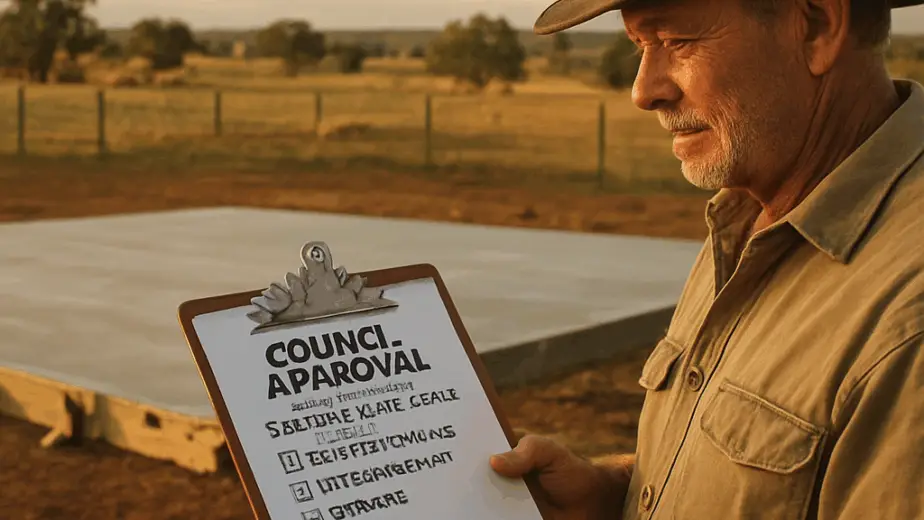
Big projects—like a new machinery shed, a major homestead extension, or a new set of stables—almost always need a thumbs-up from your local council. This can be a maze of paperwork, from Development Applications (DAs) to Construction Certificates (CCs) and finally, Occupation Certificates (OCs).
This is where a quality home improvement contractor really earns their keep. A great one will manage this whole process for you. They understand what council needs, how to lodge the paperwork correctly, and how to work with building certifiers to get every stage of the build properly signed off. It saves you from an administrative nightmare and ensures your new asset is fully legal and certified, which is crucial for insurance and the future value of your property.
Getting the Job Done: Solving Remote Project Logistics

When you're building out in the bush, logistics isn't just part of the job—it is the job. For property owners across rural New South Wales, the question is always the same: how do you get tonnes of materials and a skilled crew to a site that’s kilometres down a dirt track, maybe across a creek, and a long way from anywhere? It’s this exact hurdle that stops so many good projects in their tracks.
Plenty of contractors can handle a city build, but they come unstuck fast when faced with the reality of a remote property. A standard delivery truck gets bogged, a semi is too heavy for the old farm bridge, or the driver simply refuses to tackle the rough access road. When that happens, it’s not just a minor delay. It’s a full-blown spanner in the works that can derail your timeline and blow your budget.
This is a problem we've built our business to solve. We knew from day one that to properly service regional NSW, you have to be able to get anywhere the work is. No excuses. So, we made our entire operation self-sufficient and ready for any terrain.
Our Secret Weapon: A Fleet Built for the Bush
The heart of our logistics is our 10-tonne 4×4 truck. This isn't your run-of-the-mill delivery vehicle. It’s a purpose-built beast designed to tackle the very challenges that send other builders home. With it, we can haul a full load of materials, essential supplies, and heavy equipment to the most isolated properties.
Think of it as our mobile base of operations. This truck gives us the power to bring everything we need for a major build in one go.
- People and Gear: We transport our entire crew and all their tools directly to your doorstep, so they arrive ready to work, not waiting for a separate delivery.
- Heavy Materials: From structural steel and concrete to pallets of timber and roofing iron, we can carry it all ourselves. We don't have to rely on third-party couriers who might not even service your postcode.
- Uninterrupted Workflow: By managing our own transport, we remove one of the biggest risks in any rural project. We get what’s needed on-site, right when it’s needed.
This single capability can be the difference between a project plagued by constant supply headaches and one that runs like clockwork. For our clients, that means genuine peace of mind.
Navigating the Toughest Terrains in NSW
Our fleet, which also includes a team of supporting 4×4 utes, is specced to handle the diverse and often brutal landscapes of New South Wales. We’re regularly working on properties from the rolling hills around Tamworth and Armidale to the vast, remote stations out past Bourke and Walgett.
Maybe your place is at the end of a long black soil plain that turns to glue after a shower. Or perhaps the only way in involves a river crossing that a normal truck wouldn't dream of attempting. These are the exact scenarios we’re set up for. Our 10-tonne 4×4 truck has the high clearance and grunt to navigate these obstacles safely and reliably.
Our promise is straightforward: your location should never be a barrier to getting quality work done. Where other contractors see an impassable roadblock, we see a logistical challenge we are fully equipped to handle. This ensures your project stays on track, no matter how far off the beaten path you are.
Choosing a home improvement contractor with proven logistical muscle is non-negotiable for any rural build. It’s the only way to ensure deadlines are met, budgets are kept, and the quality of the work is never compromised because you couldn't get the right people or materials to the site. It’s this focus on practical, real-world solutions that makes us effective as dedicated outback builders for NSW properties. Our fleet isn't just about trucks; it's about delivering on our promise to be there for you, wherever "there" happens to be.
Understanding Project Costs and Realistic Timelines

When it comes to any home improvement project, two questions always come up first: "How much will it cost?" and "How long will it take?". Getting clear, honest answers is crucial. A good home improvement contractor won't just throw numbers at you; they’ll walk you through the 'why' behind them, creating a solid plan that keeps surprises out of the equation.
Figuring out the final price tag for a rural build isn't guesswork. It's a careful calculation based on several moving parts. The sheer scope of the project is the most obvious factor—a simple deck repair is a world away from a complete kitchen gut-and-rebuild that calls for plumbers, electricians, and cabinet makers. Your choice of materials also makes a huge difference to the bottom line.
Key Factors Influencing Project Costs
It’s often a balancing act between the upfront cost of materials and their long-term value. For example, spending more on premium, Australian-made steel for a new shed roof might feel steep initially, but its ability to stand up to our harsh climate means you’re not forking out for repairs or a full replacement in a few years.
Here’s a breakdown of what really drives the numbers on your quote:
- Material Choices: The quality and source of your materials matter. Opting for durable, Australian-made steel over a cheaper import impacts the initial cost, but it pays dividends in the build's lifespan.
- Project Complexity: This is all about the scope of work. A single-task job is straightforward, whereas a multi-stage renovation with different trades is a far more intricate—and costly—undertaking.
- Site Accessibility: We've touched on this before, but getting equipment and materials out to a remote property is a real logistical cost. A contractor with the right gear, like our 10-tonne 4×4 truck, can tackle this efficiently, but access is always factored into the quote.
- Labour and Trades: The cost covers not just our team's time but also any specialist tradies we need to bring in, like licensed electricians and plumbers, to ensure every part of the job meets Australian Standards.
A professional quote should never be just a single number on a piece of paper. It should be a detailed, itemised document that breaks down costs for labour, materials, permits, and any subcontractor fees. This level of transparency is a hallmark of a trustworthy contractor.
Decoding the Contract and Payment Schedule
Once you’re happy with the quote, the next step is a solid contract. This isn't just paperwork; it’s a legally binding document that protects you and your contractor by spelling out exactly who is responsible for what. It will lock in a payment schedule that’s tied to project milestones, so you’re never paying too far ahead of the work being done. A common structure is an initial deposit to secure materials, with further payments made as we hit key construction stages.
A good contract also plans for the unexpected. Things can pop up, especially when working on older rural homes. Having a contingency clause sets out a clear process for handling any changes to the original plan, ensuring you are consulted and approve any extra costs or time before work continues. For contractors, managing these large-scale projects often requires a clear understanding of business finance, including options like construction business loans to keep cash flow steady and the project on track.
Ultimately, investing in a professional from day one is the smartest financial move. When the job is done right the first time with quality materials and expert hands, you save yourself the headache and expense of future repairs. What you’re left with is a durable, valuable improvement to your property that you can enjoy for years to come.
Answering Your Big Questions About Rural Building Projects
It’s natural to have a few final questions before you commit to a major project on your property. In fact, we expect it. When it’s your home, your land, and your money on the line, you want to be completely sure you’re making the right call.
We get asked these questions all the time by families and farmers across New Soth Wales. The answers below aren’t just theory; they’re based on decades of our team being on the ground, solving these exact challenges. Our aim here is to cut through the jargon and give you the straightforward advice you need to feel confident moving forward.
How Do I Know if I Need a Simple Repair or a Full Renovation?
This is a common one. The decision to patch something up or go for a full-blown renovation really comes down to one thing: are you solving a single problem, or are you trying to improve the space for the long haul?
A repair is all about targeting an immediate issue. Think of replacing a single cracked window pane—it's a specific, contained job. A renovation, however, is a bigger-picture investment designed to boost your home's value, safety, or how you live in it.
Let's say a tap in your bathroom won't stop dripping. A quick call to a plumber for a repair makes sense. But if that same bathroom also has lifting floor tiles, the vanity is starting to swell from water damage, and the layout is just plain awkward, a renovation is the much smarter play.
A trustworthy home improvement contractor will give you an honest assessment. They’ll help you weigh up the cost of a quick fix against a proper solution that will serve you better and add real, lasting value to your property for years to come.
This professional advice is crucial. It stops you from throwing good money after bad on temporary patch-ups when a more comprehensive solution is what you really need.
What Specifically Makes a Contractor Suitable for Rural and Farm Properties?
A builder who truly gets rural and farm projects knows that a farm isn't just a home—it’s a working, breathing business. Their knowledge has to go way beyond standard residential building. They need to be intimately familiar with the unique challenges of the Australian bush, from searing heat and fine, corrosive dust to the constant threat of bushfires.
This experience directly influences their choice of materials. They'll recommend things like fire-retardant timbers and genuine Australian-made Colorbond steel because they know these products are proven to stand up to our harsh conditions.
Logistics are also non-negotiable. A proper rural contractor has to be able to get to you, no matter where you are. That means having a fleet of tough 4×4 vehicles that can handle unsealed roads, creek crossings, and muddy paddocks without a second thought.
We have a 10 tonne 4×4 truck to bring in materials and supplies for the most remote properties around New South Wales, allowing us to bring in labour, materials and equipment where and when it's needed the most.
Finally, a true rural contractor respects the rhythm of your life and work. They know how to schedule their work to cause minimal disruption to your livestock, cropping schedules, and family routine. The solutions they provide aren't just built to code; they're practical, considerate, and built to last in a demanding agricultural setting.
How Does the Quoting and Payment Process Work for a Major Project?
For any significant project, a professional contractor should provide a detailed, itemised quote. This isn't just a single figure; it’s a comprehensive document that breaks down every anticipated cost, from labour and materials to permit fees and specialist subcontractors. That level of transparency is essential for building trust and making sure there are no nasty surprises.
Once you’re happy with the quote, a formal contract is drawn up. This is a legally binding agreement that outlines the complete scope of work and a clear payment schedule, which is almost always tied to project milestones.
Here’s how it usually works:
- Initial Deposit: You’ll typically pay an initial deposit, often between 10% and 20%, to secure the booking. This allows the contractor to start ordering the first round of materials.
- Milestone Payments: As the project progresses, further payments are made when key stages are completed. This might be after the frame goes up, when the building reaches the 'lock-up stage', or once the internal linings are installed.
- Final Payment: The final balance is only paid once the project is finished to the standard set out in the contract and you are completely satisfied with the result.
This milestone-based approach protects everyone involved, ensuring work and payments stay aligned from start to finish.
Can You Work from My Ideas or Do I Need an Architect?
Absolutely, we can work directly from your ideas. In fact, some of our best and most rewarding projects began with a client's vision sketched out on a piece of paper or a folder of inspiration photos. For renovations, deck extensions, pergolas, or custom sheds, our 35 years of building experience means we can work with you to turn those ideas into a functional, compliant, and buildable plan.
Now, for very large or structurally complex projects—like a brand-new homestead or a commercial-scale shed—you will likely need formal plans from an architect to get council approval. If you already have an architect, we're more than happy to collaborate with them seamlessly.
If you don't, we can recommend experienced professionals we know and trust from past projects. Think of us as your partner in the process. Our job is to help bring your vision to life, whether it starts on a napkin or a detailed architectural blueprint.
Ready to turn your vision into a reality? The team at Awesim Building Contractors has the experience, equipment, and dedication to handle your rural home improvement project, no matter how remote. Contact us today to discuss your project.