Building a new home in rural NSW often looks more affordable on paper than building in Sydney, but the final price tag really hinges on just how "rural" you're talking about. While the base building rates in regional centres can be lower, the moment you venture out to a more remote block, a whole new set of logistical challenges can drive up the home build costs—sometimes dramatically. Getting your head around these variables from day one is absolutely key.
Understanding Your Total Home Build Costs
Starting a new build is a massive financial commitment, and the first question everyone asks is, "So, what's the real cost?" That's a loaded question, especially when you're weighing up a project in metro Sydney against one on a secluded property somewhere in New South Wales. The land might be cheaper, but the practicalities of construction bring a different kind of financial reality to the table.
As a general rule, building in established regional towns is easier on the wallet. Looking at figures for 2025, you can expect average construction costs in regional NSW to fall somewhere between $1,400 and $2,500 per square metre. That's a fair bit less than the $2,100 to $4,000 per m² you’d likely pay in Sydney.
But for truly remote properties, those baseline numbers don't paint the full picture.
The Rural vs Remote Difference
There's a world of difference between building in a well-serviced regional town and putting up a house on an isolated rural block. As soon as you move away from established roads and services, things like site access, materials transport, and finding skilled tradies willing to travel become major cost drivers.
For some of the most remote builds, these factors can push the final price to 1.5 to 2 times the cost of an equivalent project in Sydney. It sounds counterintuitive, but the logistics are everything.
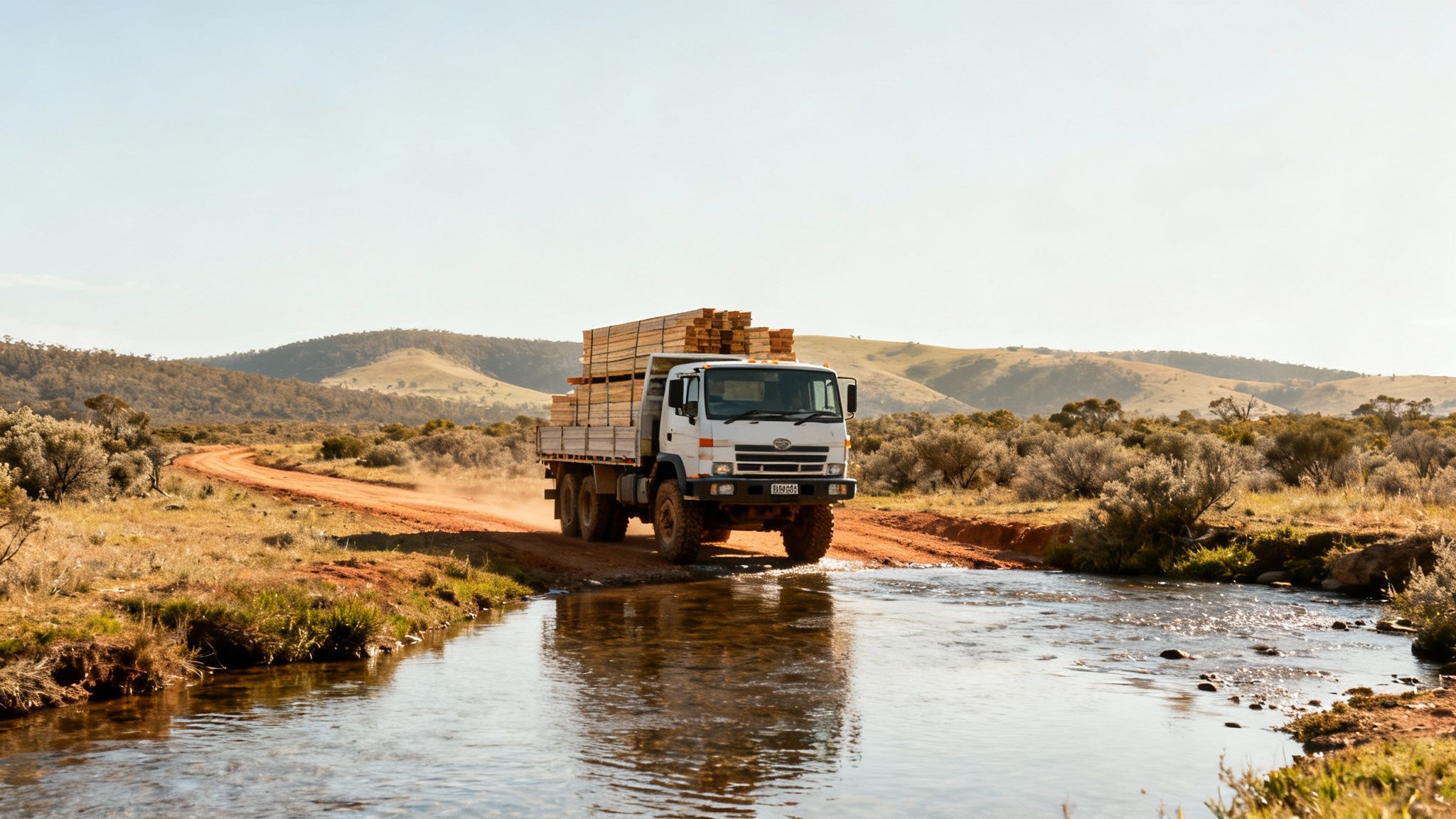
This is exactly why we invested in a specialised 10-tonne 4×4 truck, built to get materials and supplies to the most hard-to-reach properties across New South Wales. It allows us to bring labour, materials, and equipment where and when it's needed the most, navigating unsealed roads or even water crossings that would stop a standard delivery truck in its tracks. When you're calculating your total home build costs, it’s vital to factor in every expense, including detailed material costs, which you can often research on supplier sites like those with timbercloud pricing details.
The ability to efficiently get materials to a remote site is one of the single biggest factors in preventing budget blowouts. Without the right gear for the job, delays and extra costs are almost a given.
To give you a clearer picture, let’s compare the estimated costs head-to-head.
At-a-Glance Home Build Costs Per Square Metre (Sydney vs. Rural NSW)
The table below gives a high-level comparison of what you might expect to pay per square metre based on the level of finish you're aiming for. Notice how the 'remoteness factor' closes the price gap and can even make a rural build more expensive.
| Finish Quality | Estimated Cost in Sydney (per m²) | Estimated Cost in Rural/Remote NSW (per m²) |
|---|---|---|
| Standard | $2,100 – $2,800 | $1,400 – $2,500 (+ logistics costs) |
| Mid-Range | $2,800 – $3,500 | $2,500 – $3,200 (+ logistics costs) |
| High-End | $3,500 – $4,000+ | $3,200 – $4,500+ (+ logistics costs) |
As you can see, while the base rate starts lower in rural areas, the added cost of logistics for a truly remote site can quickly make it just as, if not more, expensive than a suburban Sydney build.
A solid financial plan is your most powerful tool in this process. You can get started by learning how to estimate your house construction cost with our detailed guide.
Breaking Down the Core Components of Your Build
Looking at the total cost of a new home can be overwhelming. It's far more manageable to think of it not as one giant number, but as a series of distinct stages. From the first scoop of dirt to the final coat of paint, each phase has its own budget. Breaking it down this way helps you see exactly where your money is going and gives you a much better grip on the entire process.
The real work starts long before a single wall goes up. This initial groundwork is absolutely critical, especially in rural New South Wales where the land itself often throws a few curveballs.
Stage 1: Site Preparation and Foundation
This is where it all begins—literally. Everything done here sets the stage for a stable, secure, and properly serviced home. The costs in this phase can swing wildly depending on the condition of your block.
Here’s what’s involved:
- Land Clearing and Excavation: First, we need a clean slate. This means removing trees, rocks, and any debris, then levelling the site for the foundation. A block with a steep slope or a lot of rock will naturally require more extensive (and expensive) earthworks.
- Soil Testing: We can’t guess what’s under the ground. A geotechnical report is non-negotiable; it tells us how stable the soil is, which dictates the type of foundation your home needs. Reactive clay or sandy soils, for example, often demand more complex and costly engineering.
- Foundation Pouring: A concrete slab for a standard home in a regional town might run you $15,000 to $30,000. But if your property is remote with tricky access, just getting concrete trucks and equipment there can push that cost up towards $30,000 to $60,000, sometimes more.
This is where having the right gear makes a huge difference. Our 10-tonne 4×4 truck, for instance, is invaluable for getting labour, materials, and machinery to even the most out-of-the-way properties. It helps us sidestep access challenges that would otherwise blow out your timeline and budget.
Stage 2: The Structural Lock-Up Stage
Once the foundation has cured, we get to see the skeleton of your home take shape. This is called the "lock-up" stage, and by the end of it, you’ll have a secure, weatherproof shell. It’s a massive milestone and accounts for a huge chunk of the total build cost.
This phase typically includes:
- Framing: Putting up the timber or steel frame that forms the walls and supports the roof structure. The more complex your architectural design, the more intricate and costly the framing will be.
- Roofing and Gutters: Getting the roof on is a critical step to protect the structure. For rural properties, we almost always recommend durable, Australian-made materials like Colorbond steel. It’s built to withstand our harsh weather.
- Windows and External Doors: With the windows and doors fitted, the house becomes secure and watertight.
- Cladding: This is the home's "skin." Applying the external material—whether it’s brick, weatherboard, or modern steel cladding—is what gives the home its signature look.
This flowchart gives a great visual of how the base building rate and the location factor combine to give you the final price.
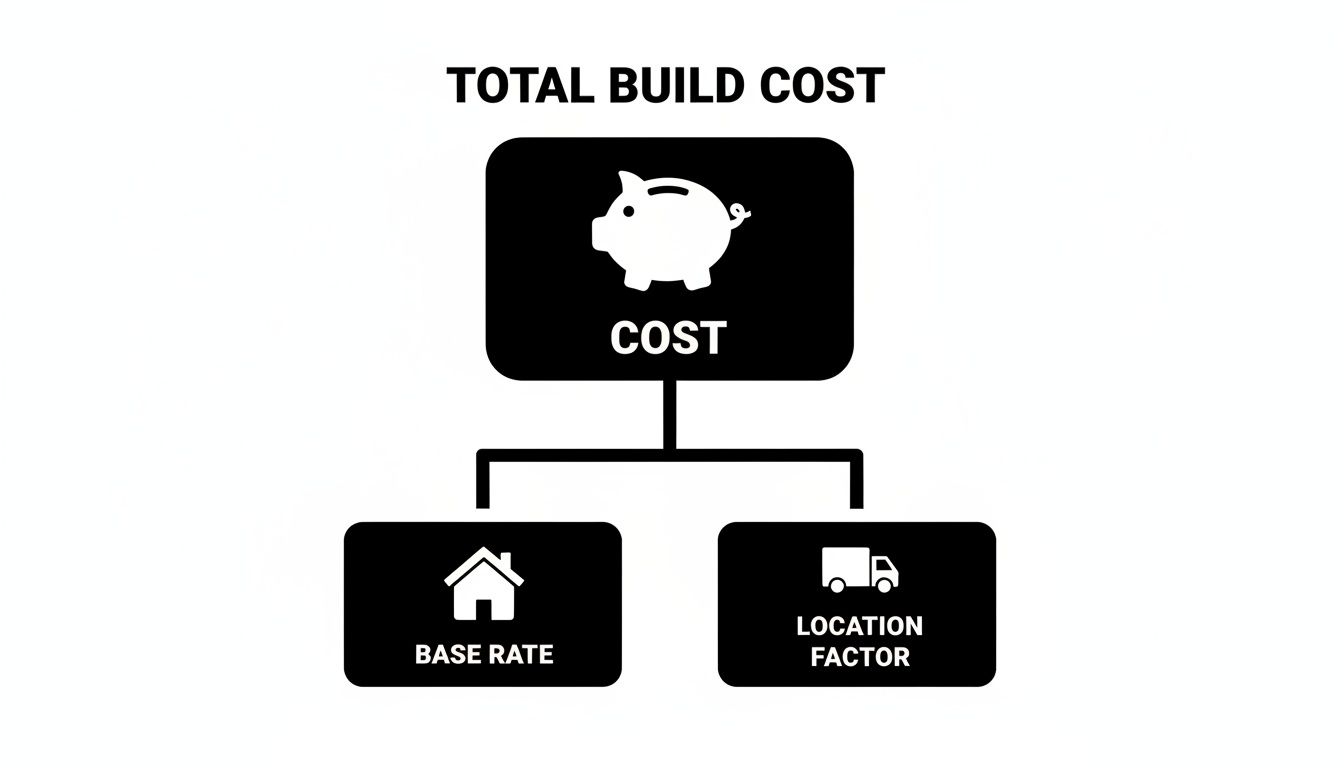
As you can see, the final number isn't just about the house itself. The logistics of getting everything and everyone to your specific spot play a huge role in the final budget.
Stage 3: Services and Internal Finishes
With the shell complete, the focus shifts inside to bring the house to life. This is where we connect all the essential services and start adding the touches that make a house feel like a home. The costs here are driven almost entirely by your personal taste and the quality of the fixtures and fittings you choose.
Connecting services in town is usually pretty straightforward. Out in the bush, it's a major project on its own. The cost to run power from the nearest pole or to install a complete off-grid septic system can be one of the biggest and most unpredictable parts of a remote build budget.
Key jobs during this stage include:
- Plumbing and Electrical Rough-In: This involves running all the necessary pipes and wiring through the wall frames before the plasterboard goes up.
- Septic Systems: If you're not on town sewerage, an on-site wastewater system is a must. This is a significant expense, often costing between $10,000 and $25,000 depending on the system type and your soil conditions.
- Interior Linings: Time for insulation, plasterboard, and the first coats of paint.
- Kitchens and Bathrooms: These two rooms are typically the most expensive per square metre. The cost covers all the cabinetry, benchtops, tiling, and fitting of fixtures and appliances.
- Flooring: The final step is laying your chosen flooring, whether that’s tiles, timber, vinyl, or carpet.
By getting your head around these core stages, you can better predict where your money will go and have much more productive conversations with your builder about keeping your project on track and on budget.
How Remote Locations Influence Your Budget
Building your dream home on a remote block in New South Wales is an incredible vision. But that idyllic isolation comes with its own unique set of financial realities.
Ever wondered why the exact same house plan can cost a fortune more when it's built miles from the nearest town compared to a suburban Sydney block? It all comes down to what we call the "remote location multiplier"—a collection of logistical hurdles that can inflate your total home build costs by 1.5 to 2 times.
This price jump isn't about the house itself. It's about the sheer effort and cost involved in getting every person, every tool, and every last nail to your specific spot on the map. In the city, everything’s just around the corner. Out on a remote property, every delivery is a major operation.
Unpacking the Logistical Challenges
Building in a remote location is a fundamentally different beast to a standard urban or even regional town project. The challenges are many, and each one adds a layer of cost that you absolutely have to factor into your budget from day one.
These challenges often include:
- Difficult Terrain: Many remote properties are accessed by unsealed dirt roads, steep tracks, or even creek crossings that a standard delivery truck simply can't handle.
- Vast Distances: The sheer distance from suppliers in regional centres means higher fuel costs, longer travel times for tradies, and serious freight charges for every single delivery.
- Labour Scarcity: Finding skilled tradespeople willing to travel hours to a remote site isn't easy. It often means paying a premium, which can include hefty travel allowances and sometimes even accommodation costs.
The tyranny of distance is the single biggest factor affecting remote home build costs. Every kilometre materials have to travel from a supplier to your site adds directly to your bottom line, turning simple deliveries into complex, expensive tasks.
This is precisely why having the right equipment becomes non-negotiable. At Awesim, for example, we run a purpose-built 10-tonne 4×4 truck. This heavy-duty vehicle is our answer to the access problem. It allows us to get labour, materials, and equipment exactly where they're needed, ensuring your project isn’t stopped dead in its tracks by a washed-out road or a flooded creek.
A Tale of Two Homesteads
To put this into perspective, let's compare the cost of a hypothetical 200m² homestead built in two very different locations.
- Location A (Sydney): A standard build of this size might come in around $600,000 ($3,000/m²). Access is easy for all trades and materials. Simple.
- Location B (Remote NSW): That same 200m² home could easily climb to $900,000 – $1,200,000 ($4,500 – $6,000/m²).
So what’s behind that staggering $300,000 to $600,000 difference? It’s the slow, steady accumulation of all those remote-specific expenses. For property owners looking to get a handle on these unique financial hurdles, your first step should be talking to experienced outback builders who can help you build a realistic budget.
This isn't just our observation; it's reflected in broader industry trends. In New South Wales, the average cost to build a new detached house hit $558,326 in the 2025 financial year, and a big part of that increase is driven by transport and logistics. These costs hit hardest in regional and remote areas, where you just can't get materials to site without specialised gear.
The extra costs for a remote build aren't just one or two big-ticket items. They are a collection of smaller, compounding factors that really add up:
- Specialised Freight: Bulk materials like timber frames, steel beams, and concrete have to be brought in on vehicles that can handle the terrain, and that service comes at a premium.
- Travel Allowances: Your electricians, plumbers, and carpenters will all factor their hours of driving time into their quotes. And rightly so.
- Equipment Hire: Getting machinery like excavators or cranes to a remote site involves "float" charges to transport them, which can easily run into the thousands.
- Waste Removal: You can't just order a skip bin. Disposing of construction waste is far more complex and costly without local services.
Ultimately, building remotely requires a total shift in mindset. Success hinges on partnering with a builder who not only understands construction but has also mastered the complex art of rural logistics.
Managing Material Costs and Supply Chains
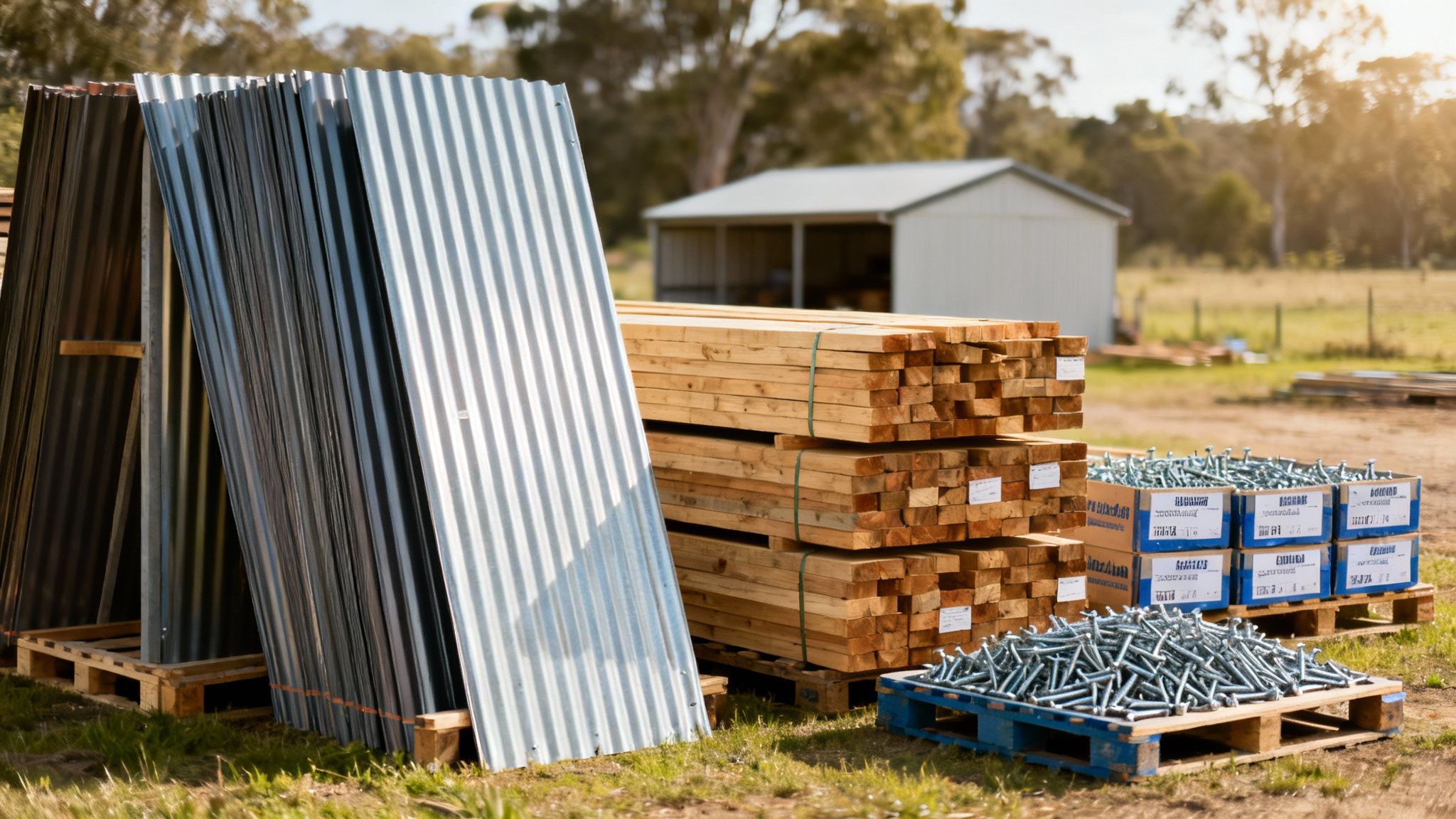
The final price tag on your new home isn’t just about the floor plan or the block of land. A huge part of the equation comes down to the raw materials needed to bring it to life. Think timber, steel, concrete, and plasterboard – the very skeleton and skin of the build. The costs of these essentials are constantly shifting with market demand, which introduces a big variable into your overall home build costs.
This price volatility is something every builder has to navigate, but the effects are often amplified when you're building in regional and remote New South Wales. It's not just the base price of materials you're dealing with; you also have the added complexity and cost of freight to get everything out to a rural property, often hundreds of kilometres from the nearest major supplier.
The Impact of Market Fluctuations
The construction industry is always a balancing act between supply and demand. Recent data shows just how much material prices can swing. For instance, by late 2025, building cost pressures in Australia were hovering near two-year highs, with house construction input prices climbing 2.1% over the year.
The Master Builders Association broke it down further, highlighting specific increases: timber and joinery were up 1.8%, metal products rose by 0.6%, and plasterboard saw a 0.5% hike. In the regional areas we service, from Tamworth to Walgett, every small price bump gets magnified by freight costs.
These might sound like small percentages, but when you're buying materials by the tonne, they can easily add thousands of dollars to your final invoice. It’s why planning ahead and working closely with your builder is absolutely crucial to keeping the budget in check.
Choosing Materials for the Long Haul
In the harsh Australian climate, especially out in the bush, picking the right materials is about more than just the upfront cost. It’s a serious investment in the long-term durability and value of your home. It can be tempting to go for cheaper alternatives, but from our experience, that's often a false economy.
At Awesim, we’re big believers in using proven, Australian-made materials that are specifically chosen to handle everything the bush can throw at them.
- Colorbond Steel: We recommend Colorbond for roofing and cladding time and time again. It’s lightweight, fire-resistant, and engineered to stand up to extreme heat, high winds, and torrential rain – a perfect match for rural properties.
- Treated Timbers: For framing and structural work, we stick to high-quality treated timbers that resist termites and rot. This ensures the bones of your home stay strong for decades to come.
- Durable Concrete: The foundation is everything. We focus on engineering and pouring high-strength concrete slabs designed for the specific soil conditions on your property. You can learn more about our approach to laying strong rural concrete foundations that last.
Yes, these premium materials might have a higher initial price tag. But their longevity and low-maintenance nature deliver exceptional value over the long run, saving you a fortune on repairs and replacements down the track.
Investing in high-quality, durable materials from the start is one of the smartest financial decisions you can make. It protects your home against the harsh rural environment and significantly reduces future maintenance costs.
Our Strategy for Supply Chain Certainty
Getting materials to a remote build site is a logistical puzzle. A single delayed delivery can halt the entire project, blow out your timeline, and add unexpected costs. This is where our specialist equipment and deep supplier relationships really make a difference.
Our heavy-duty, 10-tonne 4×4 truck is the backbone of our logistics operation. It gives us the ability to haul labour, materials, and equipment directly to even the most remote properties across New South Wales, no matter the terrain. This unique capability means we can sidestep many of the freight challenges that hamstring other builders, ensuring your supplies arrive when and where they're needed. By controlling the delivery process ourselves, we can better manage timelines and keep your project on schedule and on budget.
Budgeting for Success and Planning for Surprises
Your budget is the single most important document you'll create for your build. Think of it as your financial roadmap – it guides every decision, from the initial site survey right through to the final coat of paint. But here’s a common trap many owner-builders fall into: they focus solely on the big-ticket items like the slab, frame, and roof, and completely miss the dozens of smaller costs that can silently blow out the final figure.
These "hidden" expenses aren't really hidden at all; they're just a normal part of the building process. The problem is, they can catch you by surprise if you haven't accounted for them. Getting a firm grip on these costs right from the start is the key to keeping your project on track and on budget.
Uncovering the Pre-Construction Costs
Long before the first shovel hits the dirt, you'll face a series of preliminary expenses just to get the project off the ground. These are the non-negotiable costs that lay the groundwork for a smooth, compliant, and successful build.
It’s a bit like planning a big road trip. You budget for the obvious things like fuel and accommodation, but you also have to factor in getting the car serviced, buying maps, and paying for national park entry fees. Building a home works the same way; it’s about more than just the physical structure.
Here are some of the key expenses you need to factor into your initial budget:
- Council Application and Approval Fees: Every new build needs a Development Application (DA) lodged with your local council. These fees can easily run into the thousands and vary wildly depending on which council area your block is in.
- Architectural Design and Drafting: Unless you're using an off-the-shelf plan, you'll need a professional to draw up your blueprints. This isn't just an expense; it's a critical investment in getting the design right and ensuring it meets all the necessary building codes.
- Land Surveyor and Geotechnical Reports: You'll need a surveyor to officially peg out your property boundaries and the exact location of the house. A geotechnical engineer will then analyse the soil, which is absolutely essential for designing the right foundations for your specific site.
- Utility Connection Charges: On a rural block, just getting connected to the power grid can be a huge expense. If new poles and lines are needed, this cost can climb into the tens of thousands. You’ll also have costs for your water tank installation and septic system approvals.
At Awesim, our end-to-end service is designed to simplify this whole stage. We handle the council approvals and coordinate all these preliminary reports on your behalf. This gives you much greater budget certainty from day one and helps avoid those unexpected and costly delays that can derail a project.
The Non-Negotiable Contingency Fund
Here’s a hard truth about building: no matter how perfectly you plan, something unexpected will happen. You might hit a shelf of rock during excavation that needs heavy-duty machinery, or see a sudden global spike in steel prices. Sometimes it’s as simple as a week of non-stop rain that brings all work to a grinding halt.
This is exactly why a contingency fund is your most important financial safety net.
A contingency fund isn’t a slush fund for upgrading your benchtops. It’s a separate pool of money—we always recommend 15-20% of your total contract price—set aside purely for these unforeseen problems. So, for a $600,000 build, you should have an extra $90,000 to $120,000 tucked away.
Without that buffer, a small problem can quickly spiral into a major financial crisis. You could be forced to compromise on finishes, put parts of the project on hold, or even take on more debt to get to the finish line. Honestly, planning for the unexpected is the best way to ensure your project stays on track and your stress levels stay manageable.
Your Partner for Building in Rural NSW
Building a home in rural New South Wales throws a unique set of challenges your way. But with the right partner, a complex process becomes an incredibly rewarding journey. The real value of an experienced rural builder isn't just in their trade skills; it’s in their mastery of regional logistics and their genuine understanding of the local landscape.
Success in a remote build often comes down to overcoming the tyranny of distance. We’ve got that covered. Thanks to our specialised 10-tonne 4×4 truck, we can get labour, materials, and equipment exactly where they need to be. This beast is purpose-built for the unsealed roads and water crossings that are just part of life out here, ensuring your project stays on track.
Proven Expertise in Regional Construction
With over 35 years of specialised experience, we know what it takes to build durable, practical structures that stand up to the harsh Australian climate. Our knowledge of rural building codes and farm-friendly solutions comes from decades of hands-on work right across the region.
We offer more than just construction; we provide complete project management. From the initial designs and navigating council approvals right through to handing you the keys, our team handles every single detail.
Clear communication is the cornerstone of a successful build. We keep you in the loop at every stage, offering practical advice and transparent updates. No surprises, just progress.
Our commitment is simple: deliver a seamless experience so you can move forward with total confidence.
Bringing Your Vision to Life
From Tamworth to Bourke, we help property owners turn their plans into reality. When you're lining up a partner for your build, it’s always a good idea to connect with other local experts who get the regional picture. For instance, if you're building near Aarons Pass, speaking with a local mortgage broker in Aarons Pass can give you invaluable insight into financing options specific to the area.
Choosing your builder is the single most critical decision you'll make. By partnering with a team that has a proven track record in rural NSW, you’re not just putting up a structure. You’re investing in a smooth, well-managed project and a quality outcome that will enhance your property for decades to come. With an experienced team by your side, you can confidently turn that vision for a new homestead, shed, or renovation into a reality.
Your Rural Building Questions, Answered
Planning a build in the bush always throws up a few curly questions, especially when it comes to the budget. We get it. Here are some honest answers to the queries we hear most often from people building their dream home in rural New South Wales.
How Long Does a Build Really Take Out in the Sticks?
Look, while your mate in the suburbs might get their house up in 6-12 months, building remotely is a different beast altogether. Simple things can throw a spanner in the works. A week of heavy rain can turn an access road into a bog, holding up deliveries and trades for days.
That's why we map out a realistic schedule from day one, building in buffers for those uniquely rural challenges. It also helps that we have our own 10-tonne 4×4 truck. Being self-sufficient means we aren't waiting on third-party freight to get materials and our team to your site, no matter how far off the beaten track you are. It gives us control over the timeline that other builders just don't have.
Is It Possible to Lower the Cost Without Cutting Corners?
Definitely. Smart design is your best friend here. A simple, practical floor plan is far more cost-effective to build than a complex one with lots of corners and tricky rooflines. Material choice is another big one – using something like Colorbond steel for your roof and walls gives you a tough, low-maintenance finish without the high price tag.
If you're handy and have the gear, you could also save a bit by doing some of the early site clearing yourself.
But honestly, the single biggest way to keep your home build costs in check is to get your builder involved before the plans are finalised. We can look at the design and suggest tweaks to the construction method or materials that save you a fortune down the line without compromising the end result.
It’s all about managing those rural logistics. A $600,000 build for a 200m² home in a major centre could easily blow out to $900,000 – $1,200,000 once you factor in travel, freight, and site challenges. A builder who lives and breathes this stuff knows how to rein those costs in.
What Are the Biggest Hidden Costs I Should Brace For?
Nine times out of ten, the budget blowouts on a rural site come from two things: what’s under the ground and getting services connected. You might start digging footings and hit a seam of rock that needs an excavator with a hammer attachment, which wasn't in the original quote. Or the soil test comes back showing you need a pricier, specialised septic system.
The other big one is power. The cost to run power lines from the nearest pole to your house block can be eye-watering – sometimes tens of thousands of dollars. This is exactly why we insist on a thorough site investigation upfront and why you absolutely must have a healthy contingency fund set aside. It’s non-negotiable for a smooth project.
Ready to chat with a team that has the logistics of remote building down to a fine art? Contact Awesim Building Contractors for an obligation-free consultation. With 35 years of experience, we know what it takes to bring your vision to life in rural NSW. Find out more at https://awesim.au.