Your farm machinery is the engine of your operation. It’s also one of your biggest capital investments. Leaving tractors, harvesters, and balers out in the harsh New South Wales elements is a surefire way to watch that investment dwindle, leading to costly breakdowns and accelerated wear.
A purpose-built farm machinery shed is the single best way to protect these critical assets and your bottom line.
Protecting Your Most Valuable Farm Assets
Think about the sheer value of the equipment parked on your property. It’s the powerhouse that drives everything you do, from planting right through to harvest. Leaving it all exposed to the relentless Aussie sun, torrential rain, and ever-present dust isn't just a bit risky—it’s a guaranteed way to drive up your maintenance bills and cut years off the life of your gear.
A proper machinery shed isn't just a tin roof. It's a vital piece of farm infrastructure, designed to keep your operation running smoothly and protect your capital. A well-thought-out structure does more than keep the rain off; it creates a controlled space that shields sensitive electronics from moisture, stops rust in its tracks, and saves paintwork from getting fried by UV rays.
The True Cost of Exposure
It’s easy to overlook the hidden costs of not having proper storage. Sun-baked hydraulic hoses go brittle and split right in the middle of harvest. Morning condensation seeps into wiring, causing electrical gremlins that are a nightmare to track down.
These aren't minor annoyances. They’re the kinds of problems that bring your entire operation to a grinding halt at the worst possible time, costing you precious days and dollars. A secure, properly designed farm machinery shed is your first line of defence against these completely avoidable headaches.
An investment in a quality shed is really an investment in uptime. By protecting your machinery, you're making sure it’s ready to go when you are, eliminating those frustrating and costly delays caused by weather damage.
Reaching Every Corner of NSW
Of course, designing the perfect shed is one thing. Getting the materials and crew out to your farm, especially if you're off the beaten track, can be the real challenge. We knew this was a major hurdle for many landowners in rural and remote areas, so we sorted it.
We have a 10 tonne 4×4 truck specifically to bring in materials and supplies for the most remote properties around New South Wales. This specialised vehicle allows us to bring in labour, materials, and equipment where and when it's needed the most.
This isn't just a convenience; it's fundamental to how we work. It means we can confidently bring our team, steel, and equipment to the most far-flung properties. Whether your access is via winding dirt tracks, across creeks, or through paddocks, our logistics are dialled in. We can get the job done without a fuss, from the wide-open plains near Moree to isolated stations out past Broken Hill. It ensures that a top-quality, durable shed is well within reach for every farmer, no matter how remote their block is.
Choosing the Right Shed Design for Your Operation
Picking the right design for your farm machinery shed isn't just about putting a roof over your gear. It's a fundamental decision that shapes your daily workflow, how efficiently you operate, and how well you protect your most valuable assets for the long haul. A great shed should feel like a seamless part of your farm, making everything from parking the header to grabbing a spanner that much easier.
Think of it this way: an open-front shed is like a carport for your tractor. It gives you instant, drive-in access, which is perfect for machinery you’re using day in, day out. A fully enclosed shed, on the other hand, is more like a secure garage. It offers total protection from the elements, dust, and potential thieves, making it the ideal spot for your workshop, valuable tools, or long-term storage.
Ultimately, the best design comes down to how you run your property. There’s no one-size-fits-all answer, which is why figuring out your specific needs is always the first step.
Key Shed Designs for NSW Farms
To get the ball rolling, let’s look at the most common and practical designs you’ll see across New South Wales. Each layout has its own clear advantages, built for different types of machinery and farm jobs.
- Open-Front Bay Sheds: This is the classic machinery shed for a reason. It gives you fantastic overhead cover while allowing for quick, easy access without fiddling with doors. It’s the go-to for large, frequently used equipment like tractors and air seeders.
- Fully Enclosed Sheds: When you need top-notch security and complete protection from the weather, an enclosed shed is the only way to go. It's the perfect setup for a dedicated workshop, securing expensive gear, or storing machinery with sensitive electronics that need to be kept clean and dry.
- Drive-Through Sheds: Built for pure efficiency, these sheds let you drive massive gear like B-doubles or long implements straight through without ever needing to reverse. This design is a genuine game-changer for properties that move a lot of hay, grain, or other bulk materials.
- Combination Sheds: Many farms find a hybrid design works best, mixing open bays for easy parking with a lockable, enclosed section. This gives you the best of both worlds—quick cover for your machinery right next to a secure workshop for maintenance and tool storage.
Choosing the right mix of these features ensures your shed is a help, not a hindrance, to your farm's productivity.
Before we dive deeper, this comparison table breaks down the main shed types to help you see which might be the best fit for your needs.
Comparison of Farm Machinery Shed Designs
| Shed Type | Key Features | Best For | Considerations |
|---|---|---|---|
| Open-Front Bay | Unobstructed front access, overhead cover, simple design. | Daily-use machinery (tractors, utes), quick-access storage. | Limited security, offers no protection from driving rain or dust. |
| Fully Enclosed | Lockable doors, complete weather protection, secure. | Workshops, valuable tool storage, protecting sensitive electronics. | Access can be slower, requires good ventilation planning. |
| Drive-Through | Openings on both ends, no need for reversing. | Long vehicles (B-doubles), hay transport, bulk materials handling. | Needs more land for clear access paths on both sides. |
| Combination | Mix of open bays and enclosed, lockable sections. | Farms needing both quick-access parking and a secure workshop. | Requires careful planning of the internal layout to be efficient. |
This table shows there’s a solution for every need, from simple cover to a fully functional, secure hub for your operations.
Matching Bay Size to Your Machinery
One of the most critical parts of the design process is getting the dimensions of your machinery bays right. You're not just buying a shed for the gear you have now; you’re planning for what you might have in five or ten years. Think about your biggest piece of equipment—a combine harvester with the wings out, or a fully loaded sprayer—and plan around that.
You need plenty of clearance not just for the machine itself, but for walking around it, opening doors, and performing maintenance safely. This is where smart column placement becomes so important. It helps create those wide, clear openings that make parking a half-million-dollar machine a stress-free job.
Protecting these high-value assets is really about two things: the initial investment and ongoing security, as this diagram shows.
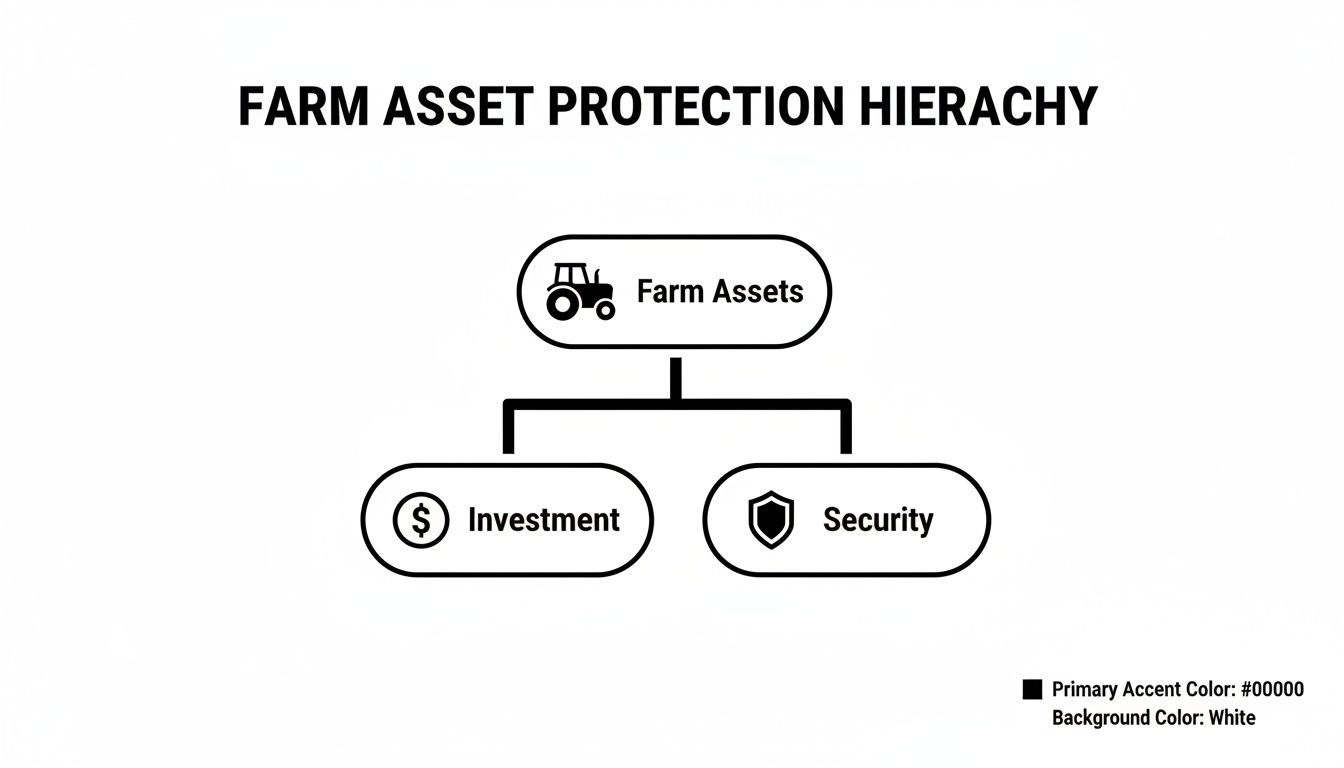
This really brings home the point that a well-designed shed isn’t just a building—it’s a core part of securing your financial investment in your machinery.
Customising for Peak Performance
A truly effective machinery shed is one that's designed for its specific location and job. Given the huge scale of agriculture in NSW, you need solutions that are both versatile and incredibly tough. For instance, gable designs can provide massive, clear-span spaces up to 24 metres wide and 60 metres long, perfect for housing the biggest gear.
By adding custom features like roller doors, personal access doors, and proper ventilation, you ensure the shed works exactly as you need it to, whether you’re farming near Moree or down in Hillston. You can get a better sense of how these impressive specifications can be adapted for your property by exploring Totalspan’s machinery shed options.
Building a Shed That Withstands NSW Conditions
A farm machinery shed is a long-term asset, not a temporary fix. It’s a serious investment that has to stand up to everything the demanding New South Wales climate can throw at it—from the scorching summer heat of the Riverina to the biting frosts of the New England highlands. This is why getting the material selection and engineering right from the start isn’t just important, it’s non-negotiable.
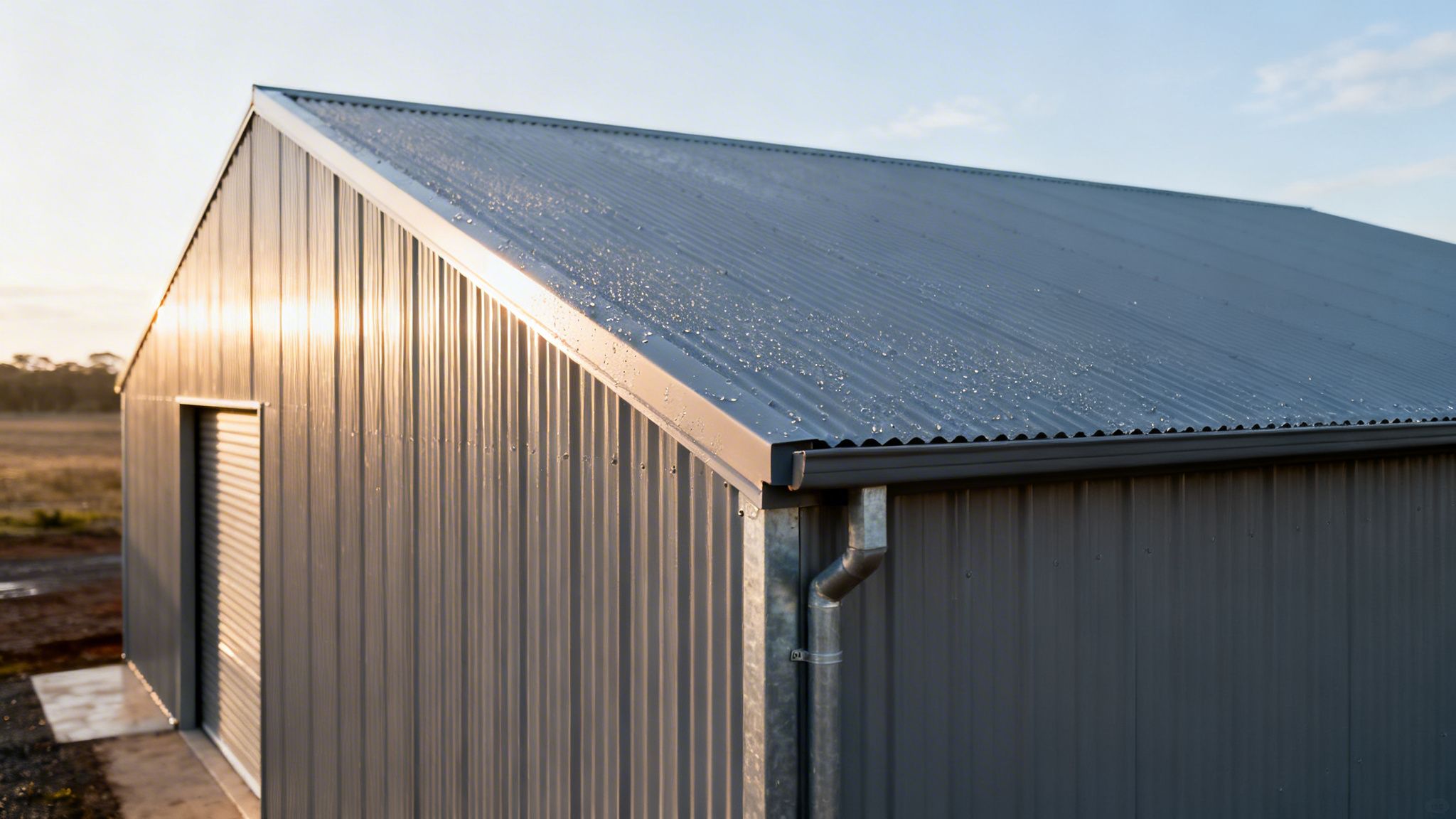
Choosing the right materials is a bit like picking the right genetics for your livestock; it sets you up for long-term resilience. That’s why we exclusively use premium, 100% Australian-made steel. Materials like Colorbond steel aren't just about looks—they are engineered for tough conditions, offering excellent corrosion resistance and even thermal efficiency, which makes a real difference in keeping the shed cooler on those blistering hot days.
This commitment to quality is what separates a shed that looks good for a year from one that stands strong for a generation, resisting rust and weathering while protecting your valuable machinery.
Engineering for Australian Realities
Beyond the materials, it's the engineering that truly guarantees your shed’s safety and structural integrity. Every region in NSW has its own unique environmental pressures, especially when it comes to wind. You simply can't put a shed designed for a sheltered valley on an exposed hilltop that gets hammered by storms.
This is where wind ratings come in. A wind rating isn't a suggestion; it's a specific engineering calculation that determines exactly how much force a structure can safely withstand, as required by Australian Standards. We engineer every shed with the correct wind rating for its specific location, so you have complete peace of mind that your assets are protected when the weather turns nasty.
Adhering strictly to Australian Standards is the bedrock of a safe and reliable build. It ensures that every component, from the footing bolts to the roof screws, is designed and installed to meet rigorous national safety criteria, safeguarding both your machinery and your people.
Site Preparation: The Unseen Hero
Even the strongest shed in the world will fail on a weak foundation. Proper site preparation is the unsung hero of any durable structure. It’s about much more than just clearing a patch of dirt; it's about creating a stable, level, and well-drained base that will support the shed for its entire lifespan.
A lot goes into getting this right, including:
- Excavation and Levelling: Creating a perfectly flat pad is the only way to ensure the structure goes up true and square.
- Drainage Solutions: You have to direct water away from the shed. It's critical for preventing waterlogging, foundation erosion, and rust.
- Compaction: Properly compacted ground provides a solid base that won't shift or sink over time, which is key to avoiding structural stress down the line.
Getting this stage right is absolutely essential. An expert guide to site preparation excavation is invaluable for laying the groundwork, and for a deeper dive into the foundation itself, learn how to determine the right https://awesim.au/concrete-slab-thickness-for-shed-a-stepbystep-guide-for-nsw-farms/.
How We Deliver to the Most Remote Properties
A successful shed build starts long before the first steel beam goes up. The real groundwork happens during site preparation—the excavation, levelling, and drainage. Getting this right is absolutely critical for a structure that will protect your valuable machinery for decades to come.
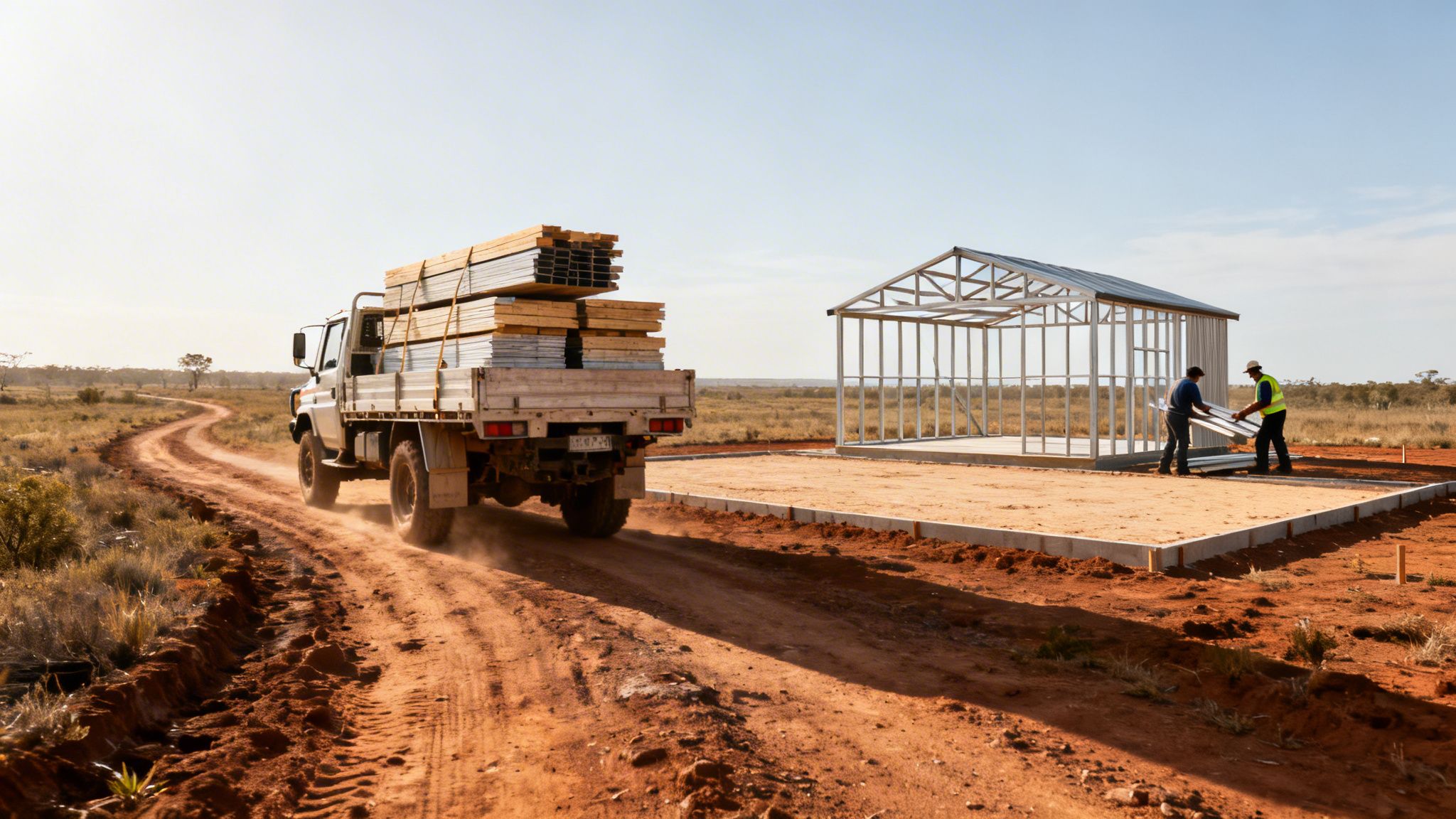
A well-poured concrete slab and smart water runoff are your best defence against rust, moisture damage, and future structural headaches. But for many farmers across New South Wales, the biggest hurdle isn't the technical stuff. It's the simple, frustrating challenge of getting materials and crews to a remote property in the first place.
And that’s where we come in.
Bridging the Gap to Rural NSW
We’ve all seen it. Long dirt tracks that turn to mud, seasonal road closures, and even the odd creek crossing. Standard delivery trucks just aren't cut out for it. This often leads to frustrating delays, damaged materials, and costs that seem to spiral out of control. It's the kind of logistical nightmare that puts essential farm projects on the back burner for years.
We saw this problem time and time again. It’s one thing to design a top-quality shed, but it's another thing entirely to get the steel, concrete, and people out to a property that's hours from the nearest big town. We knew we had to find a better way to deliver on our promises, no matter how far off the beaten track.
The ability to reliably get to a build site is the difference between a project that runs smoothly and one that never gets off the ground. For remote properties, standard logistics are often the weakest link in the chain.
Our solution is now a core part of how we operate.
Our Specialised Remote Access Fleet
To tackle these access issues head-on, we invested in a purpose-built 10-tonne 4×4 truck. This isn't your average delivery vehicle. It’s an all-terrain workhorse, specced out to handle the rugged and unpredictable conditions of rural New South Wales. With its heavy-duty suspension and four-wheel-drive, it can navigate tough country that would stop a conventional truck dead in its tracks.
This unique capability means we can bring everything needed for your shed build in one go:
- The Crew: Our skilled team arrives on-site, ready to work, without any transport hassles.
- The Materials: We can safely haul heavy loads of Australian steel, concrete supplies, and cladding right to your prepared slab.
- The Gear: All the tools and machinery for the build come with us, ensuring the team has what it needs, when they need it.
Being self-sufficient like this means we don't have to rely on third-party couriers who might not have the right vehicles or the experience to handle rural deliveries.
What This Means for Your Project
Our ability to reach the most remote corners of the state directly benefits your project. It means we can bring your vision for a new farm machinery shed to life, whether you're near Bourke, out past Broken Hill, or tucked away somewhere in between.
The advantages are tangible. By managing our own logistics with our specialised truck, we ensure the build process is smooth from start to finish. You won't be stuck waiting for a delivery that can’t make it down your driveway. This control keeps your project on schedule and on budget, removing one of the biggest headaches of remote construction.
Ultimately, it lets us provide a seamless, reliable service, guaranteeing that your property’s location is never a barrier to building the high-quality shed you need.
Sorting Out Council Approvals and Project Costs
Building a new farm machinery shed is about more than just steel and concrete. Before you even break ground, you need to get your head around council regulations and the real costs involved. It can feel like a maze of paperwork and budget spreadsheets, but getting it right from the start is the key to a smooth project.
Let's walk through what you need to know about the approval process here in New South Wales and give you a realistic idea of the investment required.
Knowing the rules and the numbers upfront saves a world of headaches—and money—down the track. It means you can plan with confidence and see your project through from a sketch on a notepad to a fully certified shed protecting your gear.
A Plain-English Guide to Council Approvals in NSW
In NSW, any new building, including your farm shed, is subject to rules set by your local council and the Building Code of Australia (BCA). The whole point is to make sure every structure is safe, well-built, and suitable for its spot. It sounds like a lot of red tape, but some of the rules are actually there to make things easier for genuine agricultural buildings.
For many rural properties, a shed used purely for farm work might fall under "exempt development." This means you can bypass a lot of the usual paperwork. Others might need a "complying development certificate" (CDC), which is a faster-track approval compared to a full-blown Development Application (DA). It usually comes down to the shed’s size, how far it sits from your boundaries, and what you’ll be using it for.
The thing is, every council area has its own local flavour when it comes to these rules. That's why your first and most important call should always be to your local council. And while you're at it, getting a handle on general requirements like planning permission for structures can give you a good background understanding of what regulators are looking for.
The Key Things That Drive Your Shed's Cost
When you're putting a budget together, you need to know what actually moves the needle on the final price. It’s not just about the raw cost of steel; a bunch of factors come together to determine your total investment. Understanding these helps you plan accurately and decide where to put your money for the best return.
Here are the main cost drivers:
- Size and Design: It’s simple, really. A bigger footprint, extra height, or a more complex layout with multiple bays and custom tweaks will cost more.
- Material Choices: We build with high-quality Australian steel as our standard, but things like Colorbond finishes, insulation, and the gauge of the steel frame can all influence the price.
- Custom Features: Thinking about adding roller doors, a personal access door for convenience, skylights, or even internal walls to create a workshop? All these practical additions will factor into the final cost.
- Your Site: A flat, easy-to-access block is always going to be cheaper to build on. If your site is on a slope, in a remote spot, or needs a lot of earthworks, drainage, or a tricky concrete pour, you’ll need to budget for that extra work.
Think of your budget as the roadmap for your project. If you account for all the variables from the start, you can sidestep nasty surprises and make sure the shed you end up with is worth every cent.
What You Can Realistically Expect to Pay
To plan properly, you need real-world numbers. The price for a good farm shed in NSW can vary, but we can look at current industry figures to give you a solid starting point for your budget. For anyone on the land, from Tamworth out to Broken Hill, this isn't just a cost—it's an investment in protecting machinery that's worth a fortune.
Looking at 2025 figures, a typical farm machinery shed in NSW will likely land somewhere between $50,000 and $270,000, fully built and including GST.
To get more specific, structural steel sheds are currently running at about $175 to $280 per square metre. Where your project falls in that range depends on its size, the specs you choose, and the logistics of your site. As an example, a very popular 40m x 18m x 6m open-front shed—perfect for both big machinery and hay storage—will often come in between $110,000 and $140,000 once it's completely installed.
If you'd like to dig deeper into the numbers, have a look at our guide on the cost to build a storage shed.
See How Custom Sheds Are Transforming NSW Farms
All the theory and specs in the world are one thing, but seeing a well-designed farm machinery shed solve real-world problems on the ground? That’s what really counts. Across New South Wales, custom-built sheds are proving to be genuine game-changers for farmers, evolving from simple storage boxes into core pieces of operational infrastructure. These aren't your standard off-the-shelf kits; they’re purpose-built solutions, engineered for a specific property, a specific workflow, and a specific set of challenges.
Take a sprawling grain property out on the Moree plains, for instance. During harvest, getting the big gear—combines and chaser bins—in and out quickly is everything. We helped design a massive, open-front shed with extra-wide 24-metre bays and a soaring clearance height of over 7 metres. This completely eliminated the frustrating, time-sapping shuffle of reversing huge machinery. Now, operators just drive straight in and out, saving precious minutes that add up to hours over a hectic harvest.
Tailored Solutions for Diverse Operations
Now, let's head over to a mixed-farming operation near Tamworth for a different story. The owner there needed a more versatile structure—something that could be a secure workshop for year-round maintenance but also offer quick cover for smaller tractors and utes.
The answer was a combination shed, designed with a bit of everything:
- Three enclosed, lockable bays with roller doors, proper concrete floors, and a full electrical fit-out. This created a secure, all-weather workshop.
- Two adjoining open-front bays to provide that immediate, convenient cover for the gear they use every day.
This hybrid design shows just how precisely a shed can be matched to the unique rhythm of a farm, giving you security where it’s needed and easy access where it counts.
A custom shed is about so much more than its dimensions. It's about intelligently placing doors, getting the bay widths just right, and choosing features that directly solve your farm's unique bottlenecks. Get that right, and your whole operation runs smoother.
Meeting the Demand Across Rural NSW
The demand for these properly thought-out structures is surging. In 2023 alone, one major builder put up around 400 farm sheds across Victoria, South Australia, and New South Wales—a clear sign of the need in regions we service, like Tamworth and its surrounds. In a country with weather like ours, these sheds are simply essential for protecting high-value assets.
One standout NSW project was a colossal 68m long by 24m wide structure, built to hold nearly 3,650 hay bales. Fully installed, a build of this scale came in between $250,000 and $275,000. You can explore more about the top farm shed projects in 2023 to get a sense of what farmers are investing in.
These real-world examples make it clear: a custom-designed machinery shed isn't just an expense. It's a strategic investment in protecting your assets and making your day-to-day work more efficient.
Common Questions About Building Farm Sheds
Thinking about a new machinery shed is a big step, and you’re bound to have questions. It's only natural. Getting straight answers is the first step toward making a sound investment for your farm. Here, we tackle some of the most common queries we hear from farmers right across New South Wales.
How Long Does It Take to Build a Machinery Shed?
The full timeline for a new farm machinery shed really depends on a few key things: how quickly your local council gets the paperwork through, the sheer size of the shed, and how complex the design is.
But once we have the council's blessing and your site is ready to go, the actual construction happens faster than you might think. For most standard machinery sheds, our team can have the whole thing built in just one to three weeks. We run a tight ship to make sure there's as little disruption to your daily operations as possible.
Is a Concrete Floor Really Necessary?
Look, it’s not legally required in every situation, but for any serious machinery shed, we’ll always recommend a professionally laid, reinforced concrete floor. It just makes sense. You get a solid, dead-level surface that’s kinder to the tyres and underbodies of your expensive gear.
A concrete slab isn't just a floor. It stops your multi-tonne header from sinking into soft ground after a bit of rain. It makes cleaning up spills a five-minute job, not a major headache. And most importantly, it acts as a moisture barrier, protecting your valuable assets from the rust and corrosion that creeps up from the ground.
Can You Build on Remote Properties with Tricky Access?
Absolutely. Getting out to remote properties isn't a problem for us—it's what we're set up for. We know that living and working in rural New South Wales often means dealing with some logistical hurdles.
That's precisely why our fleet includes a purpose-built 10-tonne 4×4 truck. This machine is designed to handle dirt tracks, creek crossings, and whatever else the terrain throws at it. This bit of kit means we can get all the crew, materials, and equipment to your site, no matter how far off the beaten track you are.
What Custom Features Can I Add to My Shed?
Your shed needs to work the way you do, and that’s where custom features come in. We can design the entire structure around the specific needs of your operation.
Some of the most popular additions our clients ask for include:
- Roller doors for secure and straightforward machinery access.
- Personal access (PA) doors so you can duck in and out without opening a whole bay.
- Skylights to flood the space with natural light and cut down on power bills.
- Whirlybirds to keep the air moving on those hot summer days.
- Internal walls to section off a secure workshop or a dust-free storage area.
For a deeper dive into the paperwork side of things, have a look at our guide on whether you need council approval for a shed in NSW.